Last summer, I briefly languished in a hospital ER with a fractured hip. I’d fallen off a horse, because I am the epitome of an adopted Texan and the definition of a displaced New Yorker. The horse I fell from was named Atlas, which feels unnecessarily cruel. Yes, it was my first time on a horse at age 34 – why do you ask?

I brought a book with me to the hospital, because I knew the wait I was facing. This prediction proved unfortunately true, but I tore through the book while awaiting x-rays and a CT scan. Starve Acre, written by Andrew Michael Hurley, is a relatively short novel, one I picked up on a whim at the bookstore because the ‘being adapted into a movie’ sticker is basically candy for me. I’m not going to spend a ton of time discussing the book here for the sake of brevity, but I enjoyed it enough to make the movie version my Octoberween pick for 2024. We do, however, have to talk about the discrepancy in taglines.
The movie (dir. by Daniel Kokotajlo) description on Prime at time of writing reads: “When their son starts acting strangely, a couple unwittingly allow dark and sinister forces into their home, awakening an ancient evil.” The book, on the other hand, “The worst thing possible has happened. Richard and Juliette Willoughby’s son, Ewan, has died suddenly at the age of five.”
I have become…apprehensive.
Richard (Matt Smith) and Juliette (Morfydd Clark) are parents to Owen (née Ewan in the book) (Arthur Shaw). The family has moved back to Richard’s family farm in the country, hoping to escape some of the downsides of city living. Owen is…violent (think Babadook but bloodier) and his parents are at odds about it. Needless to say, communication is poor. Juliette is convinced that Owen is experiencing auditory hallucinations, Richard is convinced it’s all the fantastical musings of a child, encouraged by the same lore that plagued him as a child. Neither are bad parents, really, just trying to sift through new and old trauma on their own, instead of together. When Owen dies, it’s quick and heartbreaking, even though we have only known this child for effectively twenty minutes, and that pre-existing gulf widens considerably.
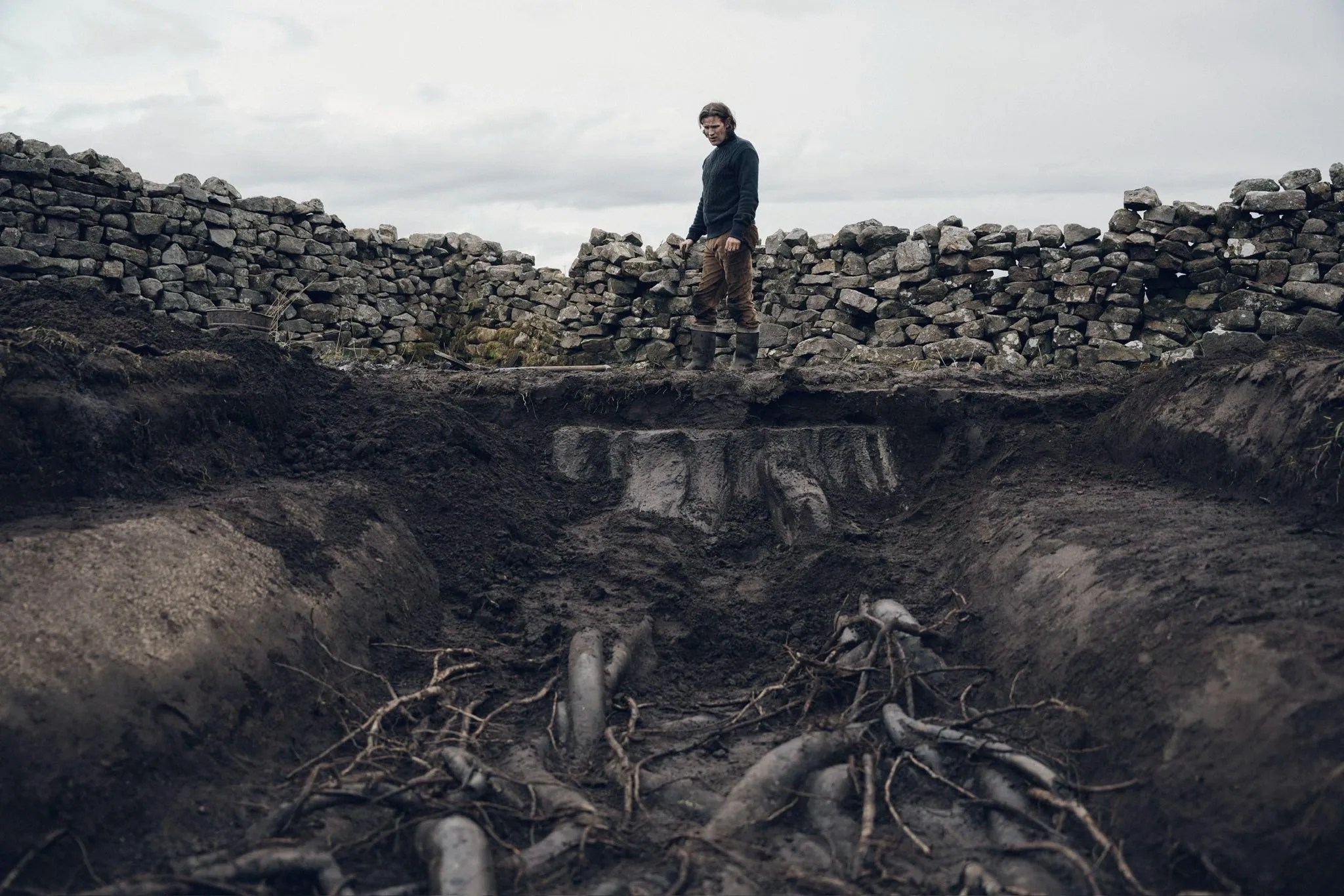
By the by, Starve Acre is the name of the farm/estate/land. An oak tree lurks beneath the grounds of the old farm, having been cut down sometime in the past but momentous enough to warrant its own mythology. They choose to show it as interstitials of dark, deep underground shots. Roots and veins and arteries, throbbing and pulsing and wet. An entire season passes in a blink after Owen’s passing, and the film is able to effortlessly establish how both parents are grieving (hint: not well). Richard has taken to his promise to Owen, excavating the land in an effort to find the roots of the ancient oak, even going so far as to tent plots of land in the dead of winter to dig. Mild spoilers ahead.
During this frenetic and compulsive personal archaeological dig, Richard unearths the skeletal body of a jackrabbit. He takes the skeleton home in a box in rough order of articulation, and finds that it has begun regenerating tissue over time, but when he takes it to a colleague, the regeneration has vanished, only to begin anew when he returns to the farm. I actually appreciated that they do not draw this sequence out, as it’s not really about Richard ‘seeing things’, more so the incredulity while he parses the discrepancy in perception. Richard then births the rabbit in a sense, nurturing and keeping it warm whilst it grows new flesh, organs, hair. Tucks it under a blanket by the fire as its heart starts beating and lungs start breathing.
The film is set in the 70s, and at the very least to my amateur eye, the color-grading and styling makes it genuinely feel like an older English folk/horror movie, closer to the style of the original 1973 The Wicker Man in overall vibe. The film is at its best at the quiet moments, where all music drops and Richard and Juliette confront each other in drips and drabs, although the overall soundscape is excellent in general.

If I had to guess, the reincarnated rabbit is a puppet about 80% of the time, and is successful only about 40% of the time, which is unfortunate because the prop work on the regenerating rabbit is excellent.
As an adaptation, I think the film does a really excellent job of establishing complex histories very quickly, albeit primarily for Richard, since it is his childhood home and personal mythology that drives the plot, despite Juliette’s sister Harrie coming for a somewhat involuntary stay. It becomes clear through the writings of his father, scant that we see them, that all was certainly not well in his childhood, and that his father was definitely abusive, and may have tried to sacrifice Richard to a tree. Just super great healthy totally normal family dynamics. I wish we would have seen more of the writings, perhaps, because it ends up rushed at the end in a deluge of information.
The movie suffers a bit towards the back third from uneven pacing, with the primary escalation happening much quicker than in the book. Consequently, they lean on telling, not showing unfortunately, and the actual division and tenuous peace between Juliette and Richard is hurried and clumsy. That being said, Matt Smith and Morfydd Clark are both excellent, intermittently playing foils for each other at different intervals.
And yes, it does include that scene.
If you were worried, as I was, that this movie about a dead child would be abundantly sad and difficult to watch, I have to admit it wasn’t quite as gut-wrenching as I feared. But it’s not really a story about Owen/Ewan so much as the aftermath, and while I think it was handled well, the film doesn’t make many attempts to pluck at your heartstrings directly. Perhaps this is because they had to juggle a mystery as well, and consequently most of the horror elements are also dropped.
 Rooster Illusion
Pingback: Octoberween: ‘The Lure’ is a Grimy, Lovely Fairy Tale | Rooster Illusion