
Ah, Halloween. One of the great adult drinking holidays, yet also a powerful source of nostalgia for a simpler, gentler time. There’s only one thing I can think of that could better represent these contradictions at the heart of the human condition: The werewolf. Whether they’re running amok in Kent or setting a precedent for Air Bud, these hirsute hellions have come to be one of Western culture’s go-to representations of our repressed primal desires.
Like many mainstays of horror, werewolves have gotten harder-edged as audiences have developed stronger stomachs and gore technology has improved (and then gotten worse during the switch from mostly practical to largely CGI effects, then sort of improved again, but we’re not getting into that). I watched The Howling (1981) recently, and man, that movie has one of the gnarliest transformation scenes I’ve ever seen. That’s not a complaint, and I certainly don’t mind a bit of the red goo every now and then. Still, a part of me did long for the comparatively tame monochrome thrills of my childhood. So here we are. I re-watched the 1941 classic and was reminded that it has far more going for it than just a lack of gore, although that certainly doesn’t hurt.
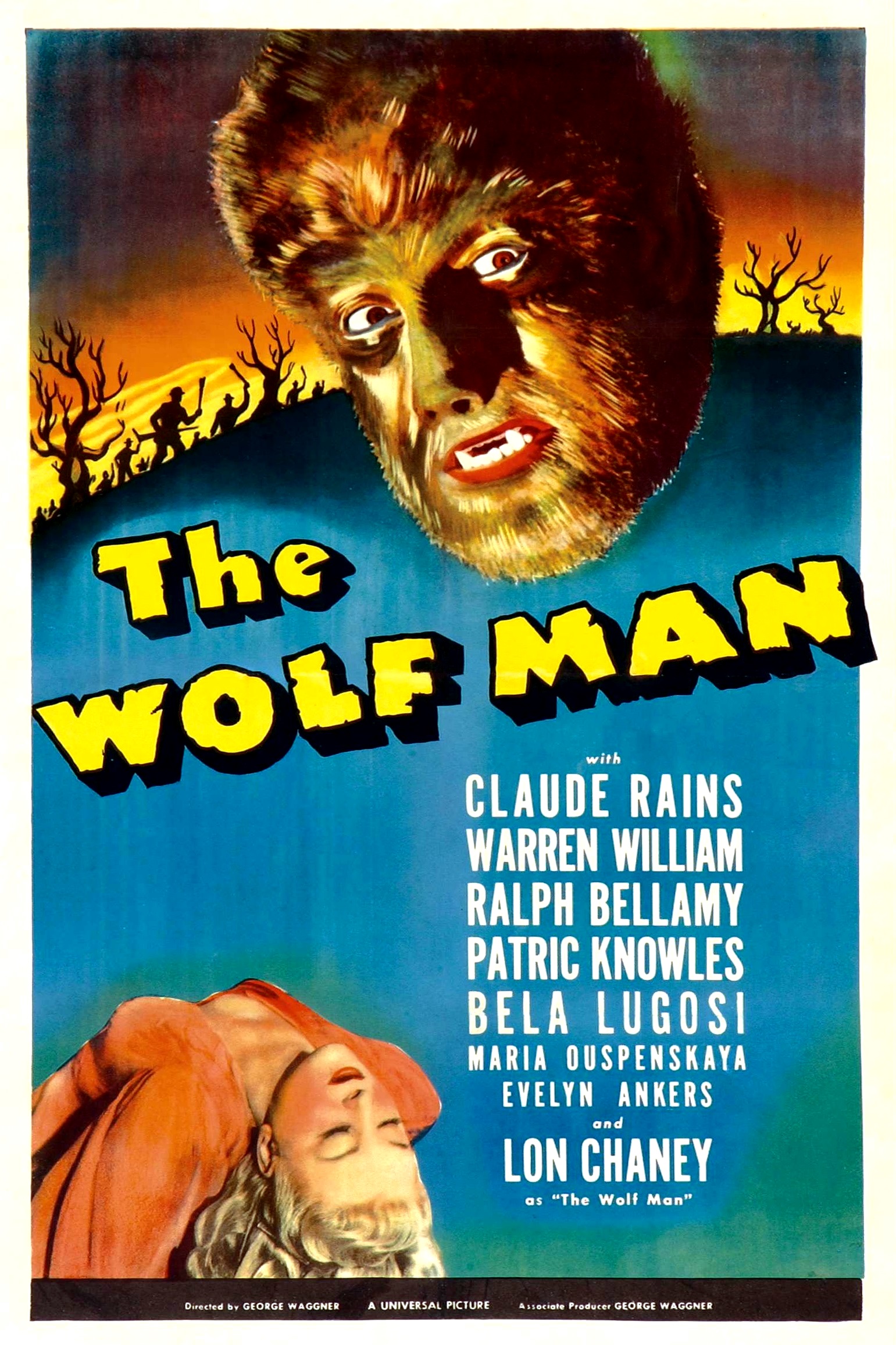
The Wolf Man (1941):
The Plot: Following the death of his older brother in a tragic hunting accident, prodigal son Larry Talbot (Lon Chaney Jr.) returns to the ancestral manor in Sunny Wales to reunite with his estranged father (Claude Raines). While attempting to woo a local antiques dealer (Evelyn Ankers) during an evening stroll through Great Britain’s foggiest woods, Larry encounters a wolf attacking another local woman (Fay Helm). Though he manages to kill the wolf, he fails to save the woman and is bitten in the process. When police find the body of a Romani fortune-teller (Bela Lugosi) instead of a dead wolf, Larry finds himself under suspicion from an increasingly hostile local populace. Worse still, more bodies start piling up and Larry can’t seem to account for his evenings anymore. Maybe there’s something to that one poem everyone in town seems to know: “Even a man who is pure of heart, and says his prayers by night/may become a wolf when the wolfsbane blooms and the autumn moon is bright.”
In the early to mid 20th century, Universal Pictures produced an iconic run of horror movies, starting with 1931’s Dracula and ending in 1956 with The Creature Walks Among Us. These films largely defined the images of classic monsters in the American public consciousness. Dracula’s evening wear and widow’s peak? Universal Pictures. Frankenstein’s monster’s green skin and neck bolts (not to mention the lightning-powered lab equipment)? Universal Pictures. The Bride of Frankenstein’s–and possibly by extension, Marge Simpson’s–hairdo? Universal Pictures. The Mummy’s–actually, we’ll give that one to the Ancient Egyptians.
The Wolf Man, while drawing from a wide range of folklore, became a source of mythmaking in its own right. It cemented the idea of a werewolf as a half-wolf half-man, and was the first film to feature the now well-established weakness to silver. It could be reasonably argued that Jack Pierce’s creature design was the werewolf in the American public consciousness for the next fifty to sixty years, maintaining its hold into the late 90s or early 00s, when the larger, more ape-like designs from The Howling and An American Werewolf in London became the default. I’d credit the mainstream breakthrough of the new design to the Underworld franchise, but that could probably be its own post.
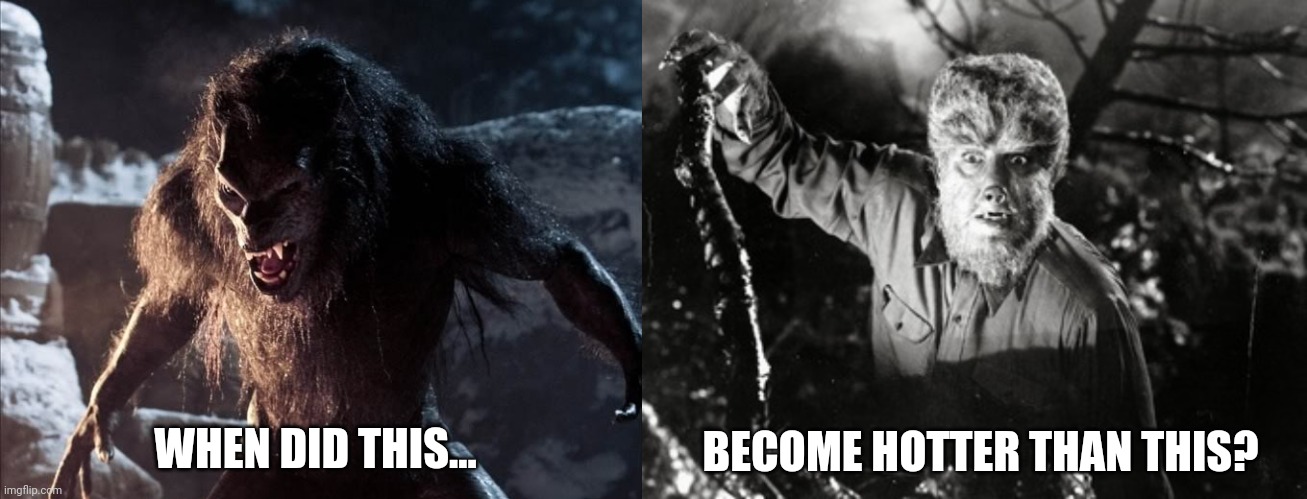
What gives The Wolf Man its lasting appeal is more than the excellent monster design. George Waggner’s direction and the atmospheric cinematography by Joseph A. Valentine lend the movie an ageless, at times almost storybook quality. The fact that The Wolf Man clearly wasn’t filmed within 5,000 miles of Wales works in its favor. Universal Pictures’ California backlot becomes, in a way, more real through its very artificiality, in much the same way that Warner Bros. brings to life the Sherwood forest of childhood fantasy in The Adventures of Robin Hood.
It’s a specific type of Hollywood set design that taps into the collective imagination. An actual Welsh village is all well(sh) and good, but the real world can feel like a paltry setting for haunting myths or heroic legends. Perhaps Terry Pratchett explains it best, in his Discworld novel Moving Pictures, a comedic-fantasy take on Silent Film-era Hollywood:
Dibbler had been right. The new city was the old city distilled. Narrow alleys were narrower, tall buildings taller. Gargoyles were more fearsome, roofs more pointed. The towering Tower of Art in Unseen University was, here, even taller and more precariously towering even though it was at the same time only one quarter the size; the Unseen University was more baroque and buttressed; the Patrician’s Palace more pillar’d. Carpenters swarmed over construction that, when it was finished, would make Ankh-Morpork look like a very indifferent copy of itself, except that the buildings in the original city were not, by and large, painted on canvas stretched over timber and didn’t have the dirt carefully sprayed on. Ankh-Morpork’s buildings had to get dirty all by themselves.
It looked far more like Ankh-Morpork than Ankh-Morpork ever had. (1)
Llanwelly, the fictional village in The Wolf Man, is Charmingly Quaint (filmed in part at Universal’s Court of Miracles, also featured in both Dracula and Frankenstein), and the forest has the kind of pea soup fog you can sink your fangs into. More real than real, larger than life. Once upon a time, there was a Man and a Wolf…
…and yet, for all that the film operates in the realm of myths and archetypes, it finds moments in its brisk 70-minute runtime to ground the characters with subtle performances and nuanced dialogue. The film will always be remembered for its place in the Cinematic Monster Cannon, and rightly so, but for me it achieves greatness in the relationship between Larry and Lord John Talbot.

Even before he’s bitten by the werewolf, there’s an undercurrent of melancholy to Larry, especially in his interactions with his father. Lon Chaney Jr. is a big man, towering over Claude Raines, but he often hunches in his presence. Time stopped for their relationship when Larry left home 18 years ago. He doesn’t know how to act around his estranged father, so we see him start reverting to the body language he used last time he was in this sprawling house. In turn his father, not knowing how to relate to this strange man, treats Larry a little like a teenager, telling him to run along into town or talking about how someday he’ll run the estate, almost implying when you’re a grown up.
What’s remarkable is that Larry doesn’t come across as childish or weak, and John never feels condescending. Each man is trying, to the best of his ability, to bridge a gap created by time and similar temperaments. The film doesn’t dwell on this. Even the scenes that directly confront the emotional elephant in the room have a deft touch, carried aloft by Chaney Jr.’s easy smile and Raines’ wry charm. The latter always gets his due as an actor for films like Casablanca, and the former doesn’t often seem to get his due at all, but they’re operating on the same level here, giving economical, subtle performances that end up being the heart of the movie.
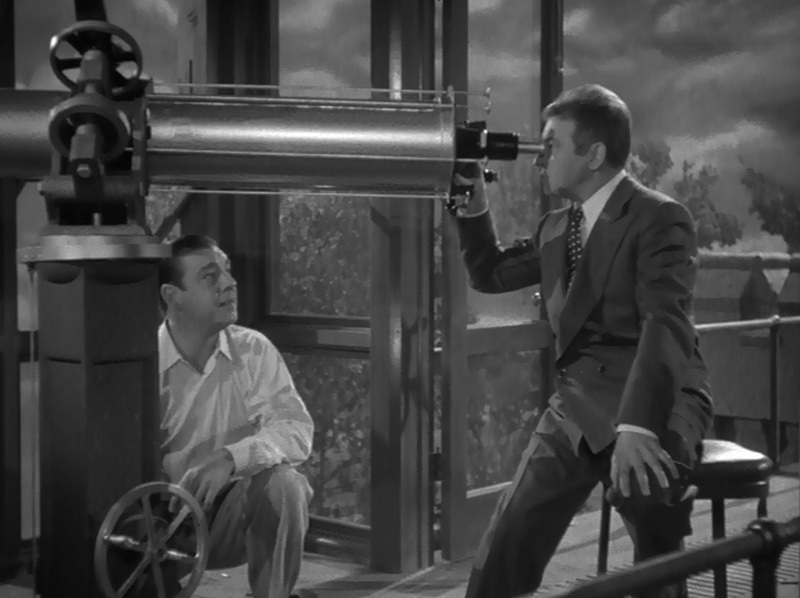
While The Wolf Man can be read as a parable about the darkness that lurks in the hearts of even good men (or about puberty, I guess, but that’s a very surface-level interpretation), I believe that it’s about a more universal experience: Being in the wrong place at the wrong time and stepping into sequence of events that sweeps you along into tragedy with the inexorability of destiny. In an interview, screenwriter Curt Siodmak described the film as being about fate:
“This was my Wolf Man fate…You know, you might go out of your house and somebody hits you with a car, go out one minute later and nothing happens to you. Que sera sera. We don’t know what is going to happen to us.” (2)
This easygoing American steps out of a “regular” life filled with technical work (“I’m alright with tools…But when it comes to theory, I’m pretty much of an amateur.”) and into the realm of legend. Though the Talbot family has an unhappy history, it’s not until he’s been bitten that Larry is truly Doomed with a capital D. Doomed to lose himself to the werewolf’s curse, just as his father is Doomed to end his own bloodline and bury the son with whom he only just reconciled.
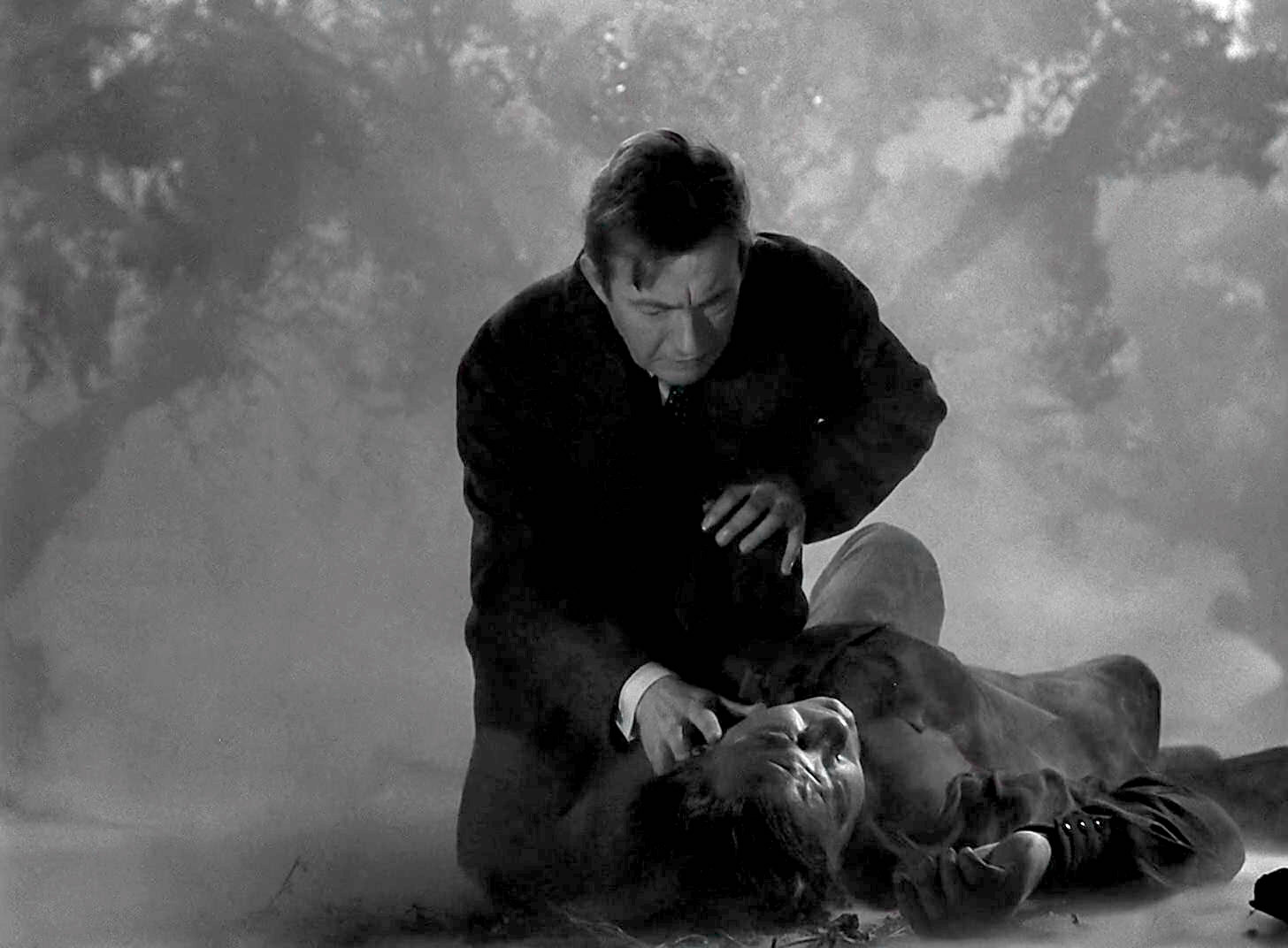
That’s the tragedy at the core of The Wolf Man: Larry Talbot doesn’t deserve this. The curse isn’t some suppressed character flaw or even a hereditary illness (the 2010 remake does attempt to go in that direction, with mixed results). Nor is it a punishment, or a supernatural intervention meant to teach a father to appreciate his wayward son. It’s just a bad thing that happens, like a hunting accident or a car crash. It could happen to anybody, even a man who is pure of heart, and says his prayers by night…
- Pratchett, Terry. Moving Pictures. ROC, 1992.
- Monster By Moonlight! The Immortal Saga of ‘The Wolf Man’. Directed by David J. Skal, hosted and narrated by John Landis, Universal Studios Home Video, 1999.
 Rooster Illusion
Wonderful review! And just in case you wondered, the idea of the werewolf man goes way back — all the way back to ancient Rome, where lycanthropy was a thing. Here’s a medical description of werewolfism: ““Men afflicted with the disease of so-called cyanthropy (dogism) or lycanthropy go out by night in the month of February in imitation of wolves or dogs in all respects, and they tend to hang around tombs until daybreak. These are the symptoms that will allow you to recognize sufferers from this disease. They are pallid, their gaze is listless, their eyes are dry, and they cannot produce tears. You will observe that their eyes are sunken and their tongue is dry, and they are completely unable to put on weight. They feel thirsty, and their shins are covered in lacerations which cannot heal because they are continually falling down and being bitten by dogs. Such are their symptoms. One must recognize lycanthropy is a form of melancholia. You will treat it by opening a vein at the time of its manifestation and draining the blood until the point of fainting. Then feed the patient with food conducive to good humors. He is to be given sweet baths. After that, using the whey of the milk, cleanse him over three days with gourd-medicine of Rufus or Achigenes or Justus. Repeat this a second and third time after intervals. After the purifications one should use the antidote to viper bites. Take the other measures too prescribed earlier for melancholia. As evening arrives and the disease manifests itself apply to the head the lotions that usually induce sleep and anoint the nostrils with scents of this sort and opium. Occasionally supply sleep-inducing drinks too.” I’m not sure I recommend the cure…
That’s really fascinating! I wonder if werewolfism occurring in February was specific to one small area, or if the “melancholia” was something akin to what would now be described as seasonal depression. Although that doesn’t entirely explain the compulsion to act like a wolf…
I certainly wouldn’t want to try the cure! Although I suppose it probably would achieve the objective of “getting the patient to stop acting like a wolf”.
As a treatment, I guess ‘knock ’em out until the fit passes’ has some merit…
Pingback: Octoberween: ‘Mary Shelley’s Frankenstein’ | Rooster Illusion