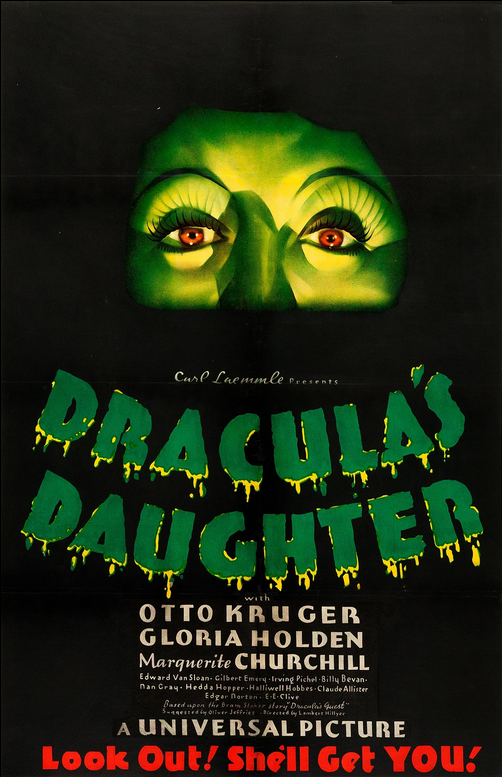
Dracula’s Daughter (1936):
The Plot: Immediately following the events of Dracula (1931), Dracula’s “daughter”, Countess Marya Zaleska (Gloria Holden), searches in vain for a cure for the vampire’s curse, which lingers even after the Count’s death. Meanwhile, Professor Von Helsing (Edward Van Sloan and yes, it really is Von Helsing in the movie) is arrested for Count Dracula’s murder and must enlist the help of a former student, psychiatrist Jeffrey Garth (Otto Kruger), to prove his sanity…and the existence of vampires! Can Dracula’s Daughter be released? Will Dr. Garth fall under her spell? Will the movie largely forget about Von Helsing’s trial?
Dracula’s Daughter had a tumultuous production. Even before the last minute casting changes—imagine The Mummy’s Zita Johann as Marya, with Cesar Romero as Dr. Garth—the film cycled through writers and storylines. The project started when Universal bought the rights to Bram Stoker’s short story “Dracula’s Guest” from MGM producer David O. Selznick (1). Having read the story, an excised chapter from Dracula that sees an unnamed narrator get lost in a snow storm before encountering a female vampire in an abandoned village, I can confirm that the filmmakers didn’t end up using it as a reference (2).
Though the film now has a reputation as an early example of lesbian vampire cinema (I’ll get into that later), early screen treatments nearly went in some very different directions. John L. Balderston, whose stage adaptation of Dracula was used as the basis for the original film and who also wrote The Mummy, wanted to go all in on S&M as the titular vamp’s defining trait (1). Journey’s End playwright R.C. Sheriff butted heads with studio censors over his (ultimately unused) script that kept the sadomasochism and added a wizard, scenes of people turning into pigs, and implications of sexual slavery at Dracula’s castle in a grim opening flashback (1). One wonders if some of this wasn’t intended to mess with the censors, who definitely deserved to have their feathers ruffled. Either way, enough of the structure from Balderston’s treatment was used in Garrett Fort’s final script that he received a story credit on the film. Not so for Sheriff.
Dracula’s Daughter is a strong sequel to the defining vampire film of the 1930s, forging its own identity with a surprisingly sympathetic antagonist. The Reluctant Vampire has been done often enough that it’s become a somewhat tired trope, but this wasn’t the case in 1936. It’s also a significant departure from Dracula, in which Bela Lugosi plays the titular monster as a suave, arrogant predator. Of all the classic Universal horror figures, Dracula is the only one who’s really evil (The Invisible Man is a bad dude, but the serum makes him insane). There are a few moments when his “person” mask slips a little and you can see the character’s animal hunger. It’s a performance that’s at once iconic and underappreciated. Bela Lugosi is not in Dracula’s Daughter, but his presence haunts the film. Countess Zaleska’s attempts to cure the “Curse of the Draculas” drive the plot. The first thing she does is burn Dracula’s corpse, holding a cross aloft and condemning him to the eternal torments of Hell. Unfortunately, this totally boss entrance isn’t enough make Zaleska human again.

At one point, Zaleska tries to explain her condition to Dr. Garth without revealing her true nature, telling him that she is plagued by “Someone… something that reaches out from beyond the grave and fills me with horrible impulses.” It is Garth’s misguided advice to “confront” these impulses and use her willpower to overcome temptation that lead to the film’s famously homoerotic “vampire seduction” scene. Zaleska, a painter in addition to being an aristocrat, has her manservant/familiar Sandor bring a model to her studio. She tells the young woman to bare her shoulders—the censors at the Production Code Administration (PCA) were adamant that “there will be no suggestion that she undresses”—and quickly succumbs to her aforementioned “horrible impulses” (1).
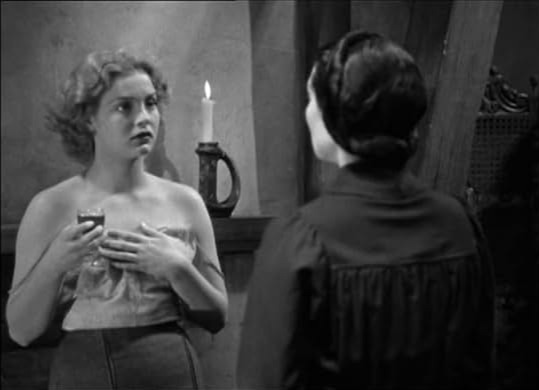
Thanks at least in part to the PCA , it’s never entirely clear what, if anything, Dracula’s Daughter means to say with its lesbian subtext. In addition to nixing any suggestion of nudity in that infamous seduction scene, the censors made clear that:
“The whole sequence will be treated in such a way as to avoid any suggestion of perverse sexual desire on the part of Marya or of an attempted sexual attack by her upon Lilli.” (1)
In yet another case of art triumphing over censorship, the scene manages to do both of those things. This subtext is largely absent from the rest of the film, returning only briefly for a scene in which Countess Zaleska hovers above a hypnotized Janet (Dr. Garth’s rich, lovelorn secretary, played by Marguerite Churchill), then slowly leans in towards her…and leans…and leans…and then is interrupted. The modern viewer can’t help but wonder if Marya and Janet might have been able to find more in common than a shared affection for Dr. Garth.
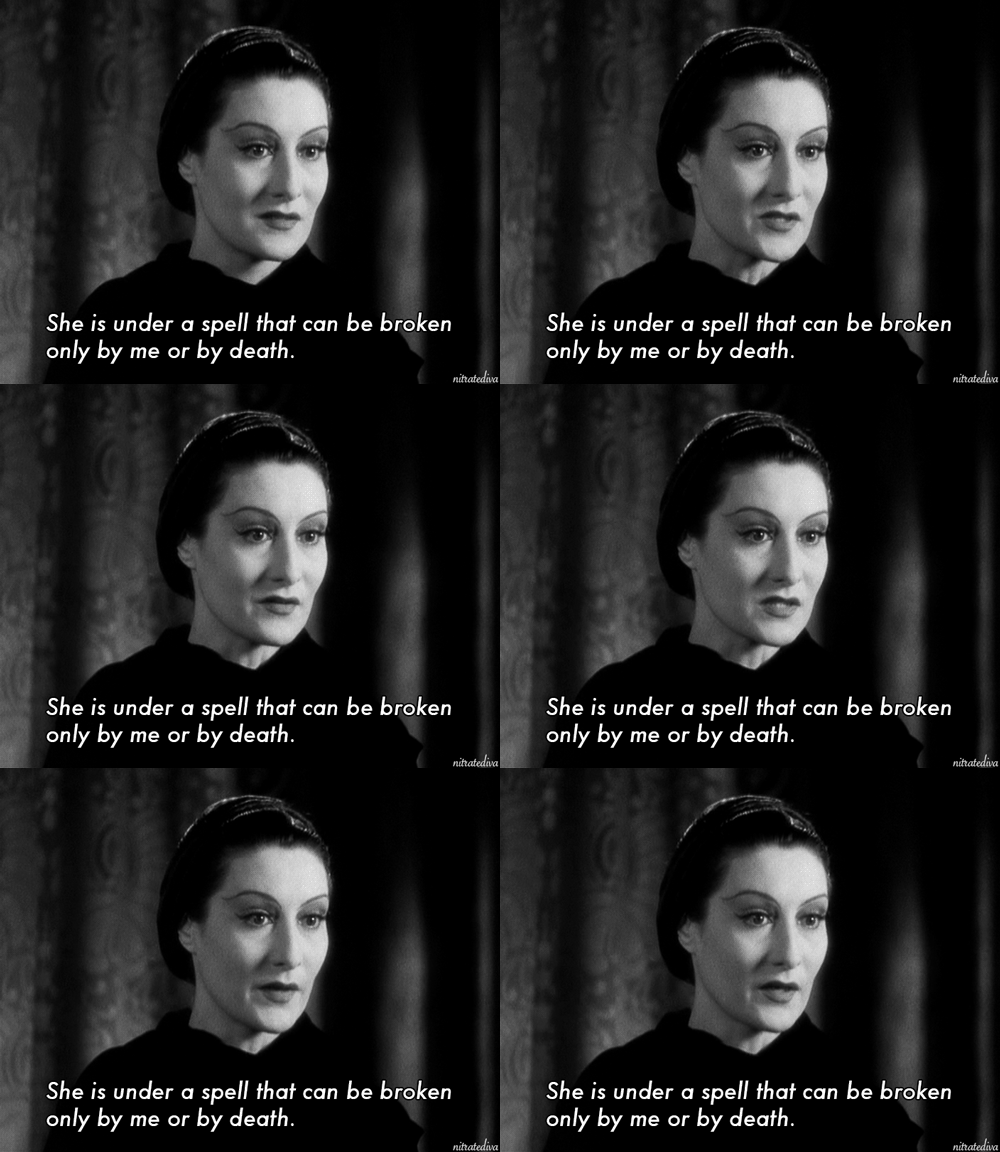
Dracula’s Daughter is often compared to Joseph Sheridan Le Fanu’s 1872 Gothic novella Carmilla, a foundational vampire text that likely influenced Bram Stoker’s Dracula twenty-five years later. While the lesbian attraction in Dracula’s Daughter is largely subtextual, in Carmilla it’s all text. The novella is told from the intended victim’s perspective, following the sheltered teen Laura’s sexual awakening and eventual realization that her new companion is more dangerous than she appears. One could argue that the vampire isn’t happy about her deadly nature, but taken at face value, the novel presents Carmilla as a cunning predator who insinuates herself into wealthy households, the better to toy with her nubile prey. A more romantic reading might see Carmilla as a tale of first love that ends in tragedy. I’d argue that either interpretation is supported by the text, although I have the feeling that Le Fanu, being a man of his time, probably intended the former.
Beyond the full circle nature of a Dracula sequel returning to vampire fiction’s sapphic roots, the two stories don’t have much in common. Dracula’s Daughter mostly follows the vampire’s perspective; the question is not whether she wants to kill, but whether she can stop. As for her sexual preferences, while she preys upon both men and women, Zaleska’s most obviously “erotic” scenes are opposite women. I have yet to come across any film criticism that suggests she is bisexual. Her male victims are presented as nothing more than food, with one notable exception. Countess Zaleska spends much of the film pursuing Dr. Garth, first as a psychiatrist and then as a potential vampire companion. One could read this as a kind of “conversion” narrative, the story of a closeted lesbian trying to “cure” herself by any means necessary. Then again…she is literally a vampire. Maybe she just wants to be able to meet a nice girl without drinking her blood.
We don’t really know much about Zaleska beyond the fact that she’s a Countess who doesn’t own any mirrors. Her precise history with Dracula is never fully explained (remember when movies left things to the imagination?). Was she adopted? Turned as a child? As an adult? Did Dracula put some noblewoman under his spell and decide that she should play the role of his daughter instead of one of his “brides”? Is her taste in victims even her taste? Dracula is clearly presented as the source of her bloodlust, and though she may eventually be resigned to her vampire fate, Zaleska only ever expresses contempt for her “father”.
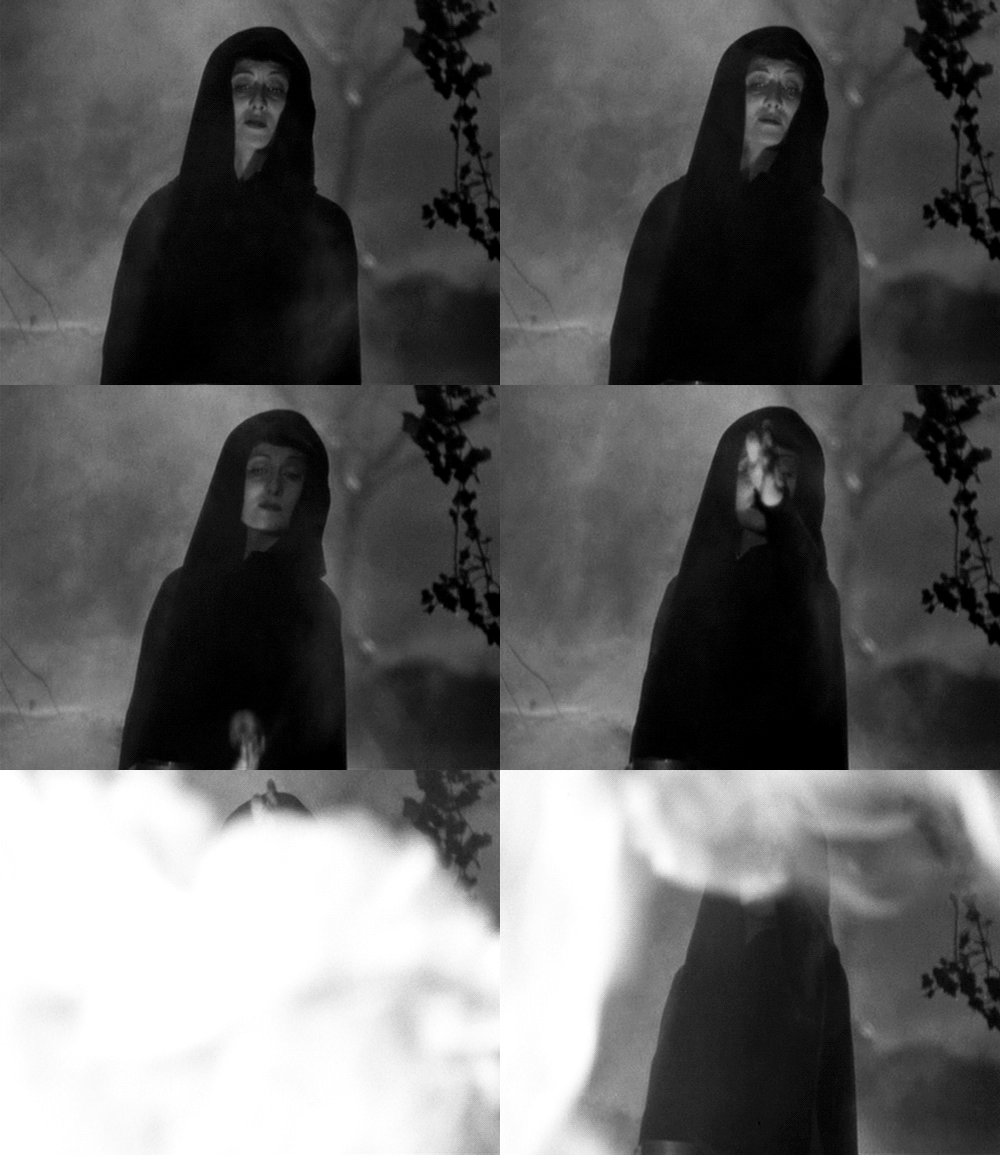
Even more than the somewhat fleeting lesbian subtext, it’s this contempt that keeps bringing me back to Dracula’s Daughter. Countess Zaleska is a sympathetic figure, driven by a desire to regain her humanity after a century of forced killing. Gloria Holden plays her with a hint of warmth beneath an icy, aristocratic exterior. A scene in which she tries to play a cheerful tune on the piano while Sandor relentlessly needles her is especially effective. Her slow realization that burning Dracula’s corpse changed nothing evokes more feeling than any scenes between the human protagonists.
While Dracula’s Daughter is, to my mind, among the best of the Universal horror sequels and a solid film in its own right, it is not without its flaws. Von Helsing’s presence is kind of wasted here, as his subplot falls to the wayside fairly quickly. “Renowned doctor goes on trial for Dracula’s murder” is an interesting premise that probably could have carried its own movie, just not this one. Otto Kruger is perfectly good as Dr. Garth, but Zaleska and Janet’s shared attraction to the character is a bit baffling. He’s a brusque, condescending authority figure whose clinical assessments keep turning out to be wrong (y’know, a psychiatrist). There’s also a recurring bit where he needs Janet to tie his bow-tie, and I just can’t see Marya Zaleska putting up with that for hundreds of years.
Despite its shortcomings, Dracula’s Daughter is more than the sum of its parts. Film fans looking for LGBTQ+ representation may be disappointed, but it’s worth appreciating as an atmospheric piece of classic horror with a captivating, tragic antagonist (what it manages to slip past the censors doesn’t hurt either).
Dracula’s Daughter is available to rent on Amazon Prime, YouTube, and Apple TV Plus.
- Rhodes, Gary D. Dracula’s Daughter. BearManor Media, 2017.
- Stoker, Bram. Dracula’s Guest and Other Weird Stories. Dreamscape Media, 2017.
 Rooster Illusion
Pingback: Octoberween: ‘Frankenstein’ | Rooster Illusion