I’ve always enjoyed doing double-feature articles, especially for Octoberween. I will be totally upfront with you, dear reader: the connective tissue is not as strong in this double-feature as I thought it was going to be. There’s a little, “do these things go together?” A question Victor Frankenstein must have asked himself often.
Bear with me.
I was, briefly, tempted to title this article “Disney’s Frankenstein”, to at least nod to the fact of The Simpsons’ new ownership. One tumbles dangerously across the railcars of a runaway train of thought (and stretches metaphors as one may, for instance, stretch a word count) when pondering the question: what would Disney’s Frankenstein look like? Thirty years ago, they would have given Mary Shelley’s Gothic horror classic the ol’ Hunchback of Notre Dame treatment: thumbing through the pages of a grim, glum novel and saying, “Yeah, we can turn this into a children’s musical.” In this day and age, I’m sure it would look and feel a little more like Alien: Romulus or Deadpool: overstuffed with visual references to other products Disney owns, and needlessly gory.
Take a glance at the list of Disney’s subsidiaries and you’ll see that it is the real Frankenstein, monster and doctor at once, a mangled hodgepodge assembled from the corpses of other enterprises, and playing God with abandon. Now that’s spooky.
Unlike today’s double-feature.
- “The Monster Frankenpooh” from Season 2, Episode 6 of The New Adventures of Winnie-the-Pooh (1989)
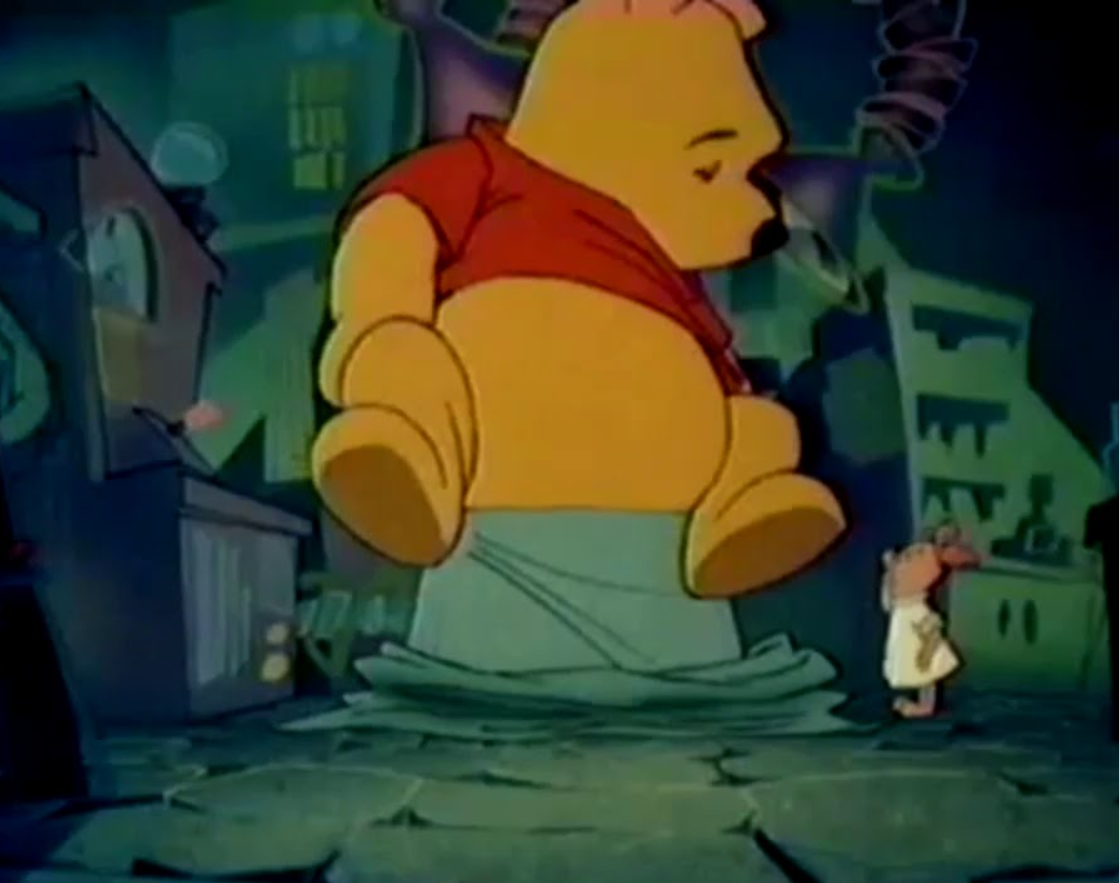
According to the Winnie-the-Pooh Wiki, Winniepedia—a source I probably never thought I’d credit—this is “based on the book ‘Frankenstein’ by Mary Shelly [sic]”.
It’s nighttime in the Hundred Acre Wood, and Tigger is craving a ghost story, “something horribibble”. Piglet starts telling the tale of the titular monster, trying desperately to keep it not-so-scary, as Tigger attempts to inject a little peril and spookiness into the narrative.
It is not, by any stretch of the imagination, “based on the book ‘Frankenstein’ by Mary Shelly [sic]”.
Frankenstein has become such a ubiquitous work—both Shelley’s novel and James Whale’s 1931 film—that you can add little references here and there and expect a five-year-old audience to know exactly what you’re getting at, even if the story you’re telling is only scary enough to frighten Piglet.
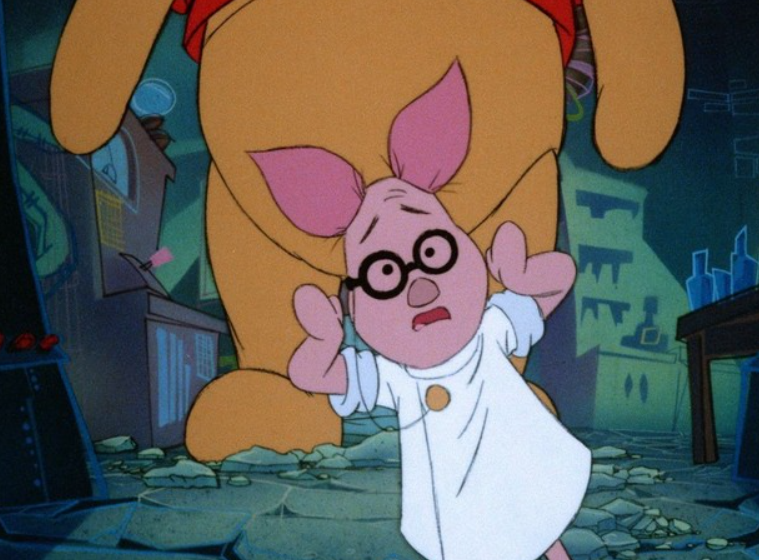
Roger Ebert once described the watercolor, gentle adventures of Pooh in the Hundred Acre Wood as “nightmare-proof”, and “The Monster Frankenpooh” does little to disprove him, and actually, that’s the point. What I found particularly striking upon reviewing this segment was the outsized (outsized much like Frankenpooh himself) space it has in my memory. I think of it as being much more than it is, but it lasts all of five minutes, a little Halloween stinger appended to a longer episode about Rabbit going overboard to keep trespassers out of his garden. There really isn’t much to it at all, but a child’s imagination has the tendency to run away with things. There’s a little nod to that at the end as Piglet’s friends calm him down. It’s just a story; it’s not real; it can’t hurt you—but Piglet (and Pooh in a visual gag), like every child, knows that stories, especially scary stories, sure do feel real.
One trusts, however, that Piglet slept soundly that night after all. Ebert, as was his wont, was completely right. No nightmares in the Hundred Acre Wood.
There are, however, nightmares in Springfield.
- The Untitled Frankenstein Bit from “Treehouse of Horror II”, Season 3, Episode 6 of The Simpsons (1991)
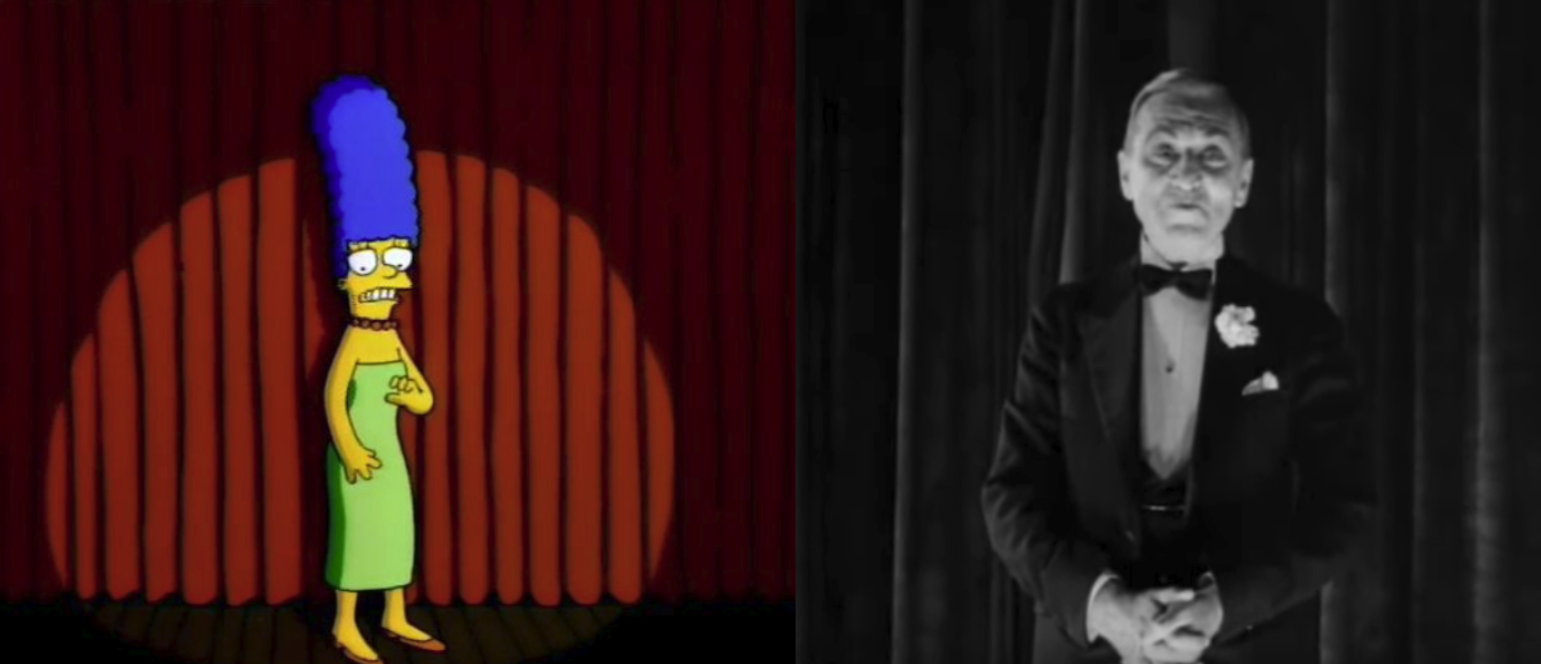
The Simpsons’ second ever “Treehouse of Horror” Halloween special begins the same way the first one does, in homage to the iconic opening of James Whale’s 1931 Frankenstein: with someone (in this case Marge) stepping out on stage in front of a curtain to urge the weak-kneed that what they are about to experience will send shivers down their spines, reaching new heights of terror. From here the writers do what all early (seasons 1–8) Simpsons writers did: treat their audience to something that was simultaneously low- and high-brow, because The Simpsons is an incredibly literate show.
We open on the titular family returning home from an evening of trick-’r-treating. Marge warns Homer, Bart, and Lisa that eating too much candy before bed will produce nightmares, they scoff, eat candy, go to bed, and three nightmares soon follow. For the sake of today’s article, I shall focus only on the final segment (he says, after 150 words of preamble).
Bart and Lisa, scared from their own nightmares, crawl into bed with Homer and Marge. After the disturbance, Homer rolls over to glance at his alarm clock and then says words every parent can relate to: “Four o’clock. Ugh, in a couple hours I have to get up and go to work.”
Anyone can have that thought at 4 a.m. but there is something particularly defeating about being woken up by your child two hours before you’re supposed to get up anyway. By the time you’ve fallen back to sleep, you’re staring down the barrel of only 60–90 more minutes, barring any future disturbances. Parental sleep deprivation is horrific in its own right. Toss in a light nightmare and we’re talking downright cruelty.
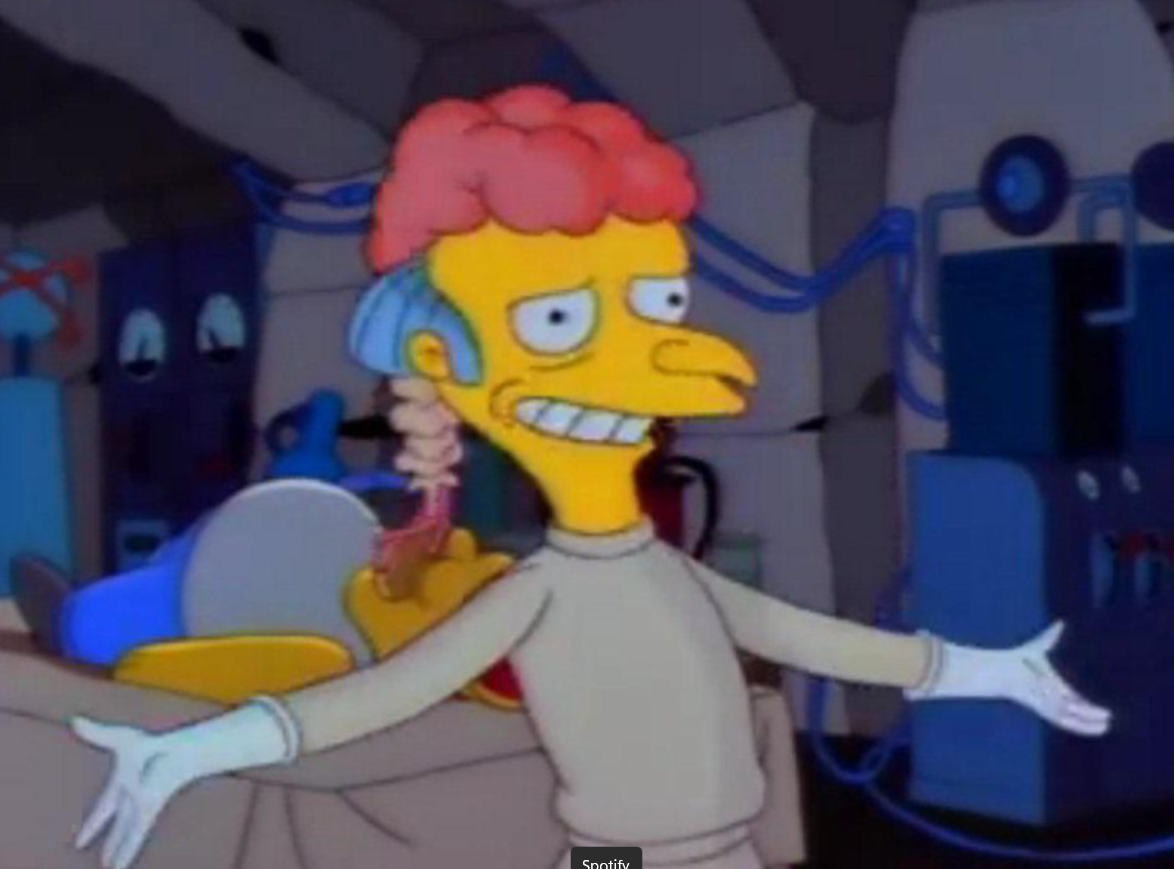
Homer’s nightmare centers on his job, although rather than your typical work anxiety dream, this subconscious fantasy instead plays, as you likely may have inferred from the context of this article, like a Frankenstein narrative. Mr. Burns is attempting to make the ideal worker, surmising that the average employee’s mind is willing enough, but his body is weak, prone to donut breaks and naps.

So he builds a giant metal working robot, and stuffs Homer’s brain into it. Just as Whale’s Frankenstein is disturbed to find that he has created a monster, Mr. Burns is devastated when the Homerbot starts smashing down walls in pursuit of donuts.
This is, by my money, one of the very greatest “Treehouse of Horror” segments, and it’s all down to Mr. Burns, whose every line of dialogue in this eight-minute episode is just flawless.
I could transcribe the entire script here to demonstrate that point. Whistling “If I Only Had a Brain” while performing surgery, railing against “that fellow at RadioShack” during the “It’s Alive” moment, his inspired use of a shovel, his Davy Crockett impression, but no other moment exemplifies these heights quite so well as this: disappointed and relenting that he was wrong to play God, Mr. Burns instructs Smithers to flush Homer’s brain down the toilet. When his subordinate suggests that perhaps the Simpson family would appreciate it if they put the brain back in Homer’s body, Burns replies, his voice hitting the perfect tone of indignant protest, “Oh, come on! It’s 11:45!”
Primetime Mr. Burns episodes are often majority conversations between him and Smithers, and in these moments I like to remind myself that they share a voice actor. It’s just Harry Shearer talking to himself, and absolutely nailing every word.
***
It’s funny about Frankenstein and Dracula and others of that ilk, the monsters we keep coming back to, we keep seeing every year, that haunt our cinemas as they haunt our dreams. You wonder, with every new adaptation, if you’re going to see something new. Will del Toro have the new ideas for Frankenstein that so desperately eluded Robert Eggers for Nosferatu? Will his vision be less gooey than Kenneth Branagh’s? These are the important questions. Regardless, I’m willing to bet that we will never again see the doctor and monster handled quite the way The Simpsons and Winnie-the-Pooh managed it, but I do know this: I just wrote nearly 1300 words about 13 minutes of television.
Happy Octoberween, everyone.
 Rooster Illusion
Pingback: Octoberween: ‘Lake Michigan Monster’ is My Kind of Silliness | Rooster Illusion
Pingback: Octoberween: ‘Frankenstein’ | Rooster Illusion