Zing. Still got it.
I’m bridging the gap between last week’s review of 28 Years Later and this coming Friday’s review of Good Boy (a movie that’s actually still in theaters?!) with a heartwarming tale of a boy and his zombie…
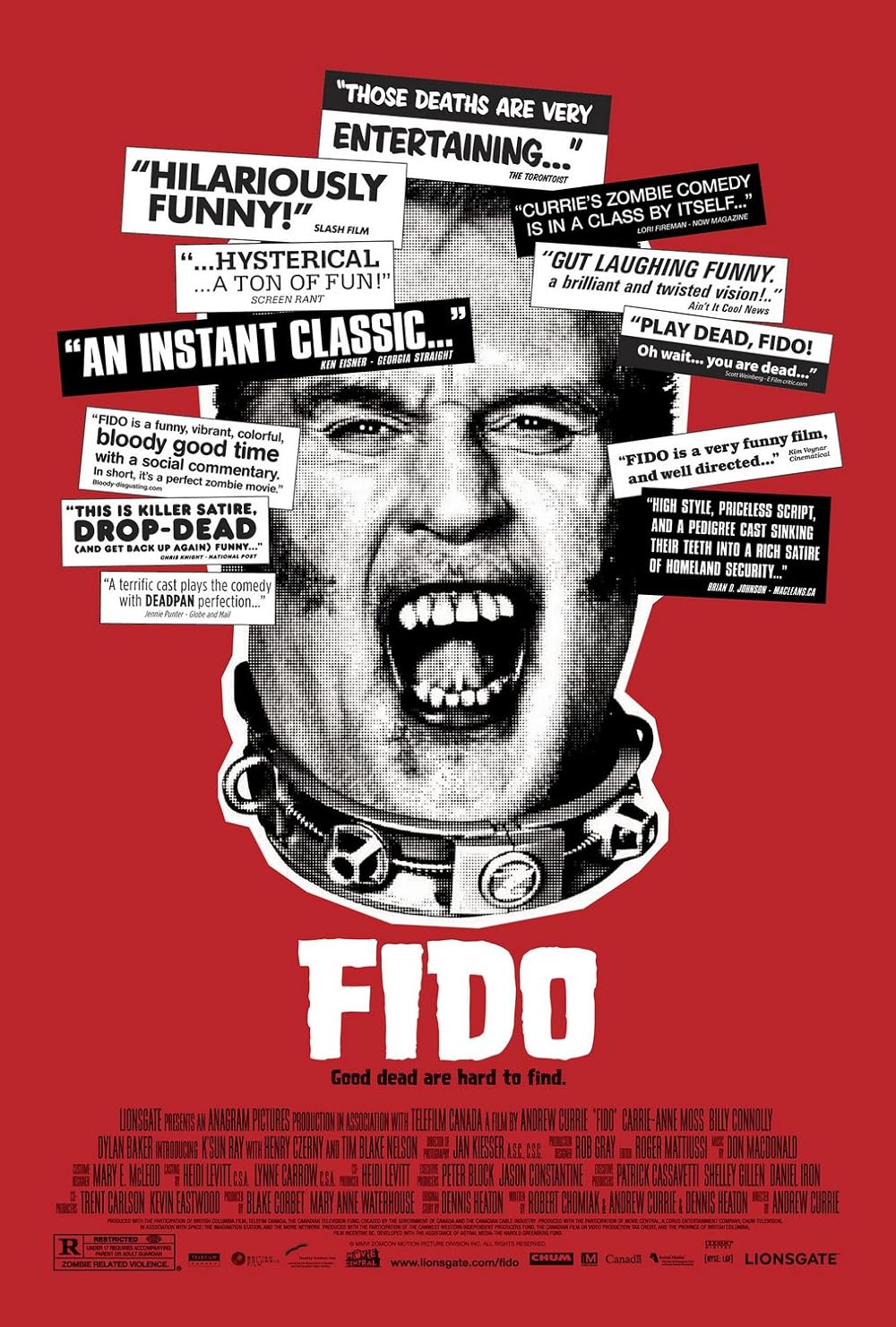
Fido (2006):
The Plot: On an alternate 1950s Earth, space radiation causes the dead to rise. After humans emerge victorious from the ensuing Zombie Wars, the living dead are fitted with hi-tech collars that turn them into docile household slaves. The film follows the Robinson family in the town of Willard: Shy kid Timmy (K’Sun Ray), dissatisfied housewife Helen (Carrie-Anne Moss), and uptight loser Bill (Dylan Baker). Helen gets more than she bargained for when she ignores her husband’s zombie phobia and buys a zombie to help out around the house (Billy Connolly). Bullied Timmy adopts the shuffling corpse as a sort of pet/confidante, naming him Fido. It’s not long before Timmy learns the importance of leash laws and the bodies start piling up. Will Timmy be able to keep Fido safe from mean authority figures led by ZomCon agent Mr. Bottoms (Henry Czerny)? Will Helen revive her flagging marriage? Will Bill find the strength to stand up for his family? And just what exactly is the nextdoor neighbor, Mr. Theopolis (Tim Blake Nelson), doing over there with his zombie Tammy (Sonja Bennett)? All this and more in Fido!
While 2004’s Shaun of the Dead didn’t invent the zombie comedy (or zom-com), it sure had a lot of copycats in the mid-aughts. Thankfully, Fido isn’t one of them*. This Canadian indie production is a genuine effort to make something original and entertaining. However, the screenplay by Robert Chomiak, Dennis Heaton, and director Andrew Currie almost focuses too much on the former, getting bogged down by its own worldbuilding. The table-setting is quickly dispatched with an upbeat newsreel chronicling the Zombie Wars and explaining ZomCon’s dual role as corporate savior and governing body. It’s an interesting world, but the details and unexamined implications get in the way of the comedy.
The light-hearted parody elements work better than the attempts at more pointed satire. Fido can’t quite seem to figure out what, if anything, it’s trying to say with its use of zombies as slaves. Is Fido a person? What about Tammy, the neighbor’s teenage zombie “girlfriend”? If they are people, then do the Lassie references or Mr. Theopolis’s cheerful perversity work as jokes? If they aren’t, then does the happy ending? If all this is meant to be in service of suburban satire, does it mean anything that Fido‘s world of living “haves” and undead “have-nots” is populated exclusively by white people? I don’t know, and neither does the film. Fido tries to have its brain and eat it too. For all that, it’s often charming.
Fido is at its funniest when it keeps things simple, finding humor in the juxtaposition of zombie violence with Lassie tropes or Douglas Sirk-ian suburban drama. Moments like Helen explaining that she bought a zombie in order to keep up appearances (“The neighbors have six!”) or Bill reading a copy of Death magazine in bed may lend themselves more to sensible chuckles than outright guffaws, but a good time is a good time.

Chipper ’50s archetypes talking about the undead could get old fast, but the film mostly manages keep things feeling fresh during its 93-minute runtime. Fido takes the Robinsons and their domestic woes slightly more seriously than one might expect based on the premise. K’Sun Ray is good as Timmy, holding his own opposite the adult cast. Carrie-Anne Moss and Dylan Baker manage to bring some depth to their characters, finding the humanity in what could easily have been shallow roles. The film also benefits from the presence of Henry Czerny and Tim Blake Nelson, both excellent character actors. Billy Connolly, known for his lyrically profane stand-up (and delightful cameo in Muppet Treasure Island), is an odd choice for a character who can only communicate in grunts and groans. However, he gives an often subtle comedic performance, the restraint allowing for more emotional moments to land.
Perhaps Fido‘s greatest strengths are its costuming and production design. Costume designer Mary E. McLeod (A Christmas Story, Wild America, Drive Angry) and production designer Rob Gray (Shattered, Falling Skies) create a bright and colorful world that is the perfect visual contrast to the decaying bodies and occasional dismemberments. McLeod’s costumes faithfully recreate the style of post-war haute couture; the cinched waists and clear lines of Helen’s dresses suggest Dior’s “New Look”1. The town of Willard is a vision of 1950s nostalgia as instantly recognizable as it is artificial. It’s the ’50s of our collective imagination, drawn from Leave It to Beaver and B-horror movies like The Blob or Them!
While Fido does bite off more than it can chew, its ambitions are commendable. Solid direction, a game cast, and a quirky sense of humor mostly make up for the film’s shortcomings. Zombies have certainly been burdened with enough metaphors to last a(n) (after)lifetime, but the mixed messaging ultimately keeps Fido from becoming a Halloween classic.
Fido is currently available to rent online at Amazon Prime and Apple TV+.
*If anything, the more obvious comparison would be to the 2005 video game Stubbs the Zombie in Rebel Without a Pulse. The two don’t really have anything in common beyond the 1950s setting and the presence of zombies, though. Stubbs the Zombie is a goofy parody in which the undead hero can use farts to incapacitate enemies and engages in a punishingly difficult (to this player, anyway) dance-off with the chief of police. It also has a great soundtrack.
1. Nii, Rei. “The Age of Technological Innovation – Fashion in the Second Half of the 20th Century”. Fashion History From the 18th to the 20th Century, edited by Akiko Fukai, Taschen, 2004.
 Rooster Illusion
Pingback: Octoberween: ‘Frankenstein’ | Rooster Illusion