
Picture this, if you will: Octoberween, 2021: the Korean Wave washes over Netflix, introducing millions of Americans to subtitles; a Saudi consortium purchases Newcastle United for £300 million, introducing thousands of Geordies to sportswashing; a returning Second Breakfast writes a multipart series touching upon all of Christopher Lee’s turns as Count Dracula in Hammer films, introducing more than one reader to a movie I could only describe as “too groovy for its own good”; and the domestication of the dog continued unabated.
Scene set.
The Dracula piece is the only one that’s really relevant for this article. Given my pre-established adoration for Lee’s counterpart, real-world best friend, and on-screen nemesis Peter Cushing, it feels prudent that I should double back on that series. As I noted in my first installment, setting the scene for Lee’s return as the Count in Dracula: Prince of Darkness (and yes, here I go quoting myself for the second time this article), “In 1960, two years after Horror [of Dracula], Cushing returns in The Brides of Dracula, to take care of a few other vampires, though Christopher Lee is absent. Lee doesn’t reprise the role and return from the grave until ’66, but we are, sadly, without Cushing’s Van Helsing now until 1972.”
You’ll have to forgive this self-reference (although as Disney repeatedly asserts and box office earnings affirm, self-reference is both A) the highest form of entertainment and B) the only form of reference you can reliably trust your audience to get).
So naturally given the focus of that series I didn’t elaborate upon Cushing’s Lee-free outing in The Brides of Dracula, nor did I later even mention the fact that after slaying Dracula yet again in Lee’s final outing, The Satanic Rites of Dracula, Cushing in fact reprised his Van Helsing for one last role in a singularly wild film, Legend of the 7 Golden Vampires,billed as the “first kung-fu horror spectacular,” but more on that later.

First: Brides. The title is noteworthy for being a wild misnomer. The central vampire here is one Baron Meinster, a disciple of the late Count with a few brides of his own. For much of the film we follow a young Frenchwoman who unwittingly stumbles into the Baron’s fiendish clutches and is soon groomed to join his undead harem. I say “soon”, but this episode is the entire first half of the movie before Cushing’s Van Helsing makes an appearance to save the young lady from the onset of vampirism and do battle with Meinster and his brides.
The film runs a tight 85 minutes and greatly benefits from the direction of Terence Fisher, who also directed Horror of Dracula and several other Hammer films, distinguishing himself as the studio’s best filmmaker (he did not, admittedly, have severe competition). The first half is a compelling enough vampire drama, but one does find oneself tapping one’s foot in anticipation of Peter Cushing’s arrival, and the film certainly gains momentum once he appears.
He really picks up where he left off. His Van Helsing is the perfect blend of well-spoken academic and man of action. He’s a gentleman of action. He never shies away from grappling and light fisticuffs, happy to run and jump when the situation calls for it, but also enjoys a brandy in the evening with his reading. Doesn’t mind getting his hands dirty, but, you know, prefers to wear gloves.

One thing I always enjoy about this series is their willingness to play around with the vampire lore in order to come up with new and occasionally gnarly ways to kill vampires, so that you’re not just staking them or shining a little sunlight their way. This does, however, sometimes produce wild leaps in logic. Van Helsing, for instance, really stretches the notion of vampires not being able to cross running water in Dracula: A.D. 1972, when he dispatches one of Dracula’s goons by pushing him into a shower. In Brides, though, it looks like Baron Meinster is about to escape when Van Helsing, perched atop a windmill, leaps onto one of the sails, dragging the arms of the giant into such a position that the moon casts a shadow in the form of a cross, exactly as the Baron runs through, and the holy symbol destroys him. This feels dicey to me. Vampires, I have to imagine, just can’t pose much of a threat when the very act of encountering a perpendicular intersection could prove lethal.
Now, Brides of Dracula has all the necessary hallmarks of an early 1960s Fisher-directed Hammer vampire romp. Fast-forward to 1974 and by golly, a few things have changed.

We open in the familiar setting of the creepy Carpathians. A Transylvanian shepherd—haplessly minding both his flock and his own business—soon finds himself spooked by an unfamiliar sight: a long-haired, brightly garbed, hunched, Fu-Manchu-sporting Chinese vampire wizard. One of those. This chap has been on a long pilgrimage, he soon exposits, to resurrect Count Dracula in hopes that the Prince of Darkness will restore his own vampire clan (the titular 7 Golden ones) to their former glory back in China. Dracula, who is very noticeably not played by Christopher Lee here, soon kills his new would-be disciple, possesses his corpse, and heads east.
And herein lies the first of many life lessons one can glean from Legend of the 7 Golden Vampires: Should fate, the cosmos, or some higher power compel you to journey 7,000 miles on foot, over mountain and across steppe and desert, don’t celebrate arriving at your final destination by awaking a vampire. Or any ancient evil, really. It’s not a good way to cap off a long holiday.
Meanwhile Cushing’s Van Helsing is touring universities in China and Hong Kong, presently lecturing in Chongqing on the existence of vampires and in particular providing the audience with more background information on the 7 Golden Vampires.
Now I’ve been beating around the bush long enough. I teased with the phrase “first kung-fu horror spectacular” and I didn’t deliver. In a way, that’s appropriate. That term is 75% accurate. A wise man once warbled, “Two out of three ain’t bad”, so one must presume three out of four is pretty good. The math tracks.
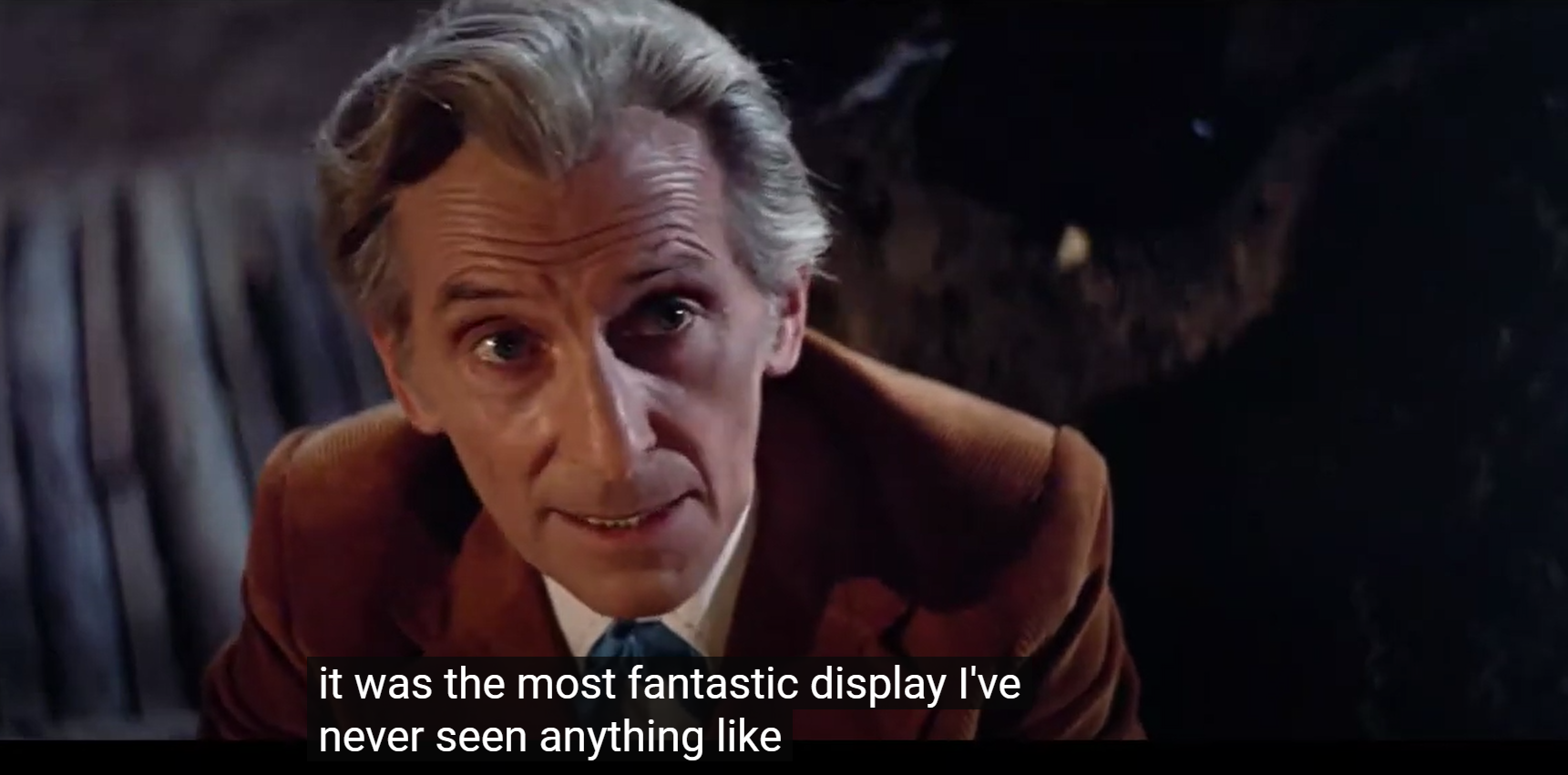
Where Legend may fail to achieve the spectacular, it excels in, well, being from 1974. They do give Van Helsing a mop-headed son, whose whole character may best be described by the word “dork”. And I am really glad I wrote that sentence down when I was watching the movie, because I had forgotten about him by the time I came back to write the rest of the article, even though he’s a central character.
Yes, this is a bad movie. Peter Cushing, mourning the recent death of his beloved wife, boarded the project because he thought working a solid gig in Hong Kong would do him some good. Cushing’s close friend Christopher Lee reportedly urged him against taking the role, on the basis of the dismal script—and to that, sir, I say “pishposh”. Both Lee and Cushing had boarded worse movies on the virtues of worse scripts, and those had nary a whiff of kung-fu to boot. I mean, they both agreed to The Satanic Rites of Dracula, and as long as we’re on the topic of dismal scripts, we can’t very well ignore that chestnut, eh?
At the end of the day, though, Cushing had a rare gift for imbuing dismal scripts with a sense of wit, charm, humanity, and gentlemanly dignity. He had a tremendous range and a noble commitment to his profession and his professionalism. It’s true, though he was a “gentleman of action” in the Horror and Brides of Dracula years, he failed to produce any kung-fu of his own against the 7 Golden Vampires and their undead army of darkness. Still, what a way to open the books on a brand new genre: the kung-fu horror spectacular, still going as strong as ever 50 years later, all thanks to this one crazy dream, and the brave men and women who dared make it a reality. Where would we be without them?

 Rooster Illusion
Pingback: Octoberween: ‘The Lure’ is a Grimy, Lovely Fairy Tale | Rooster Illusion