And so, another Octoberween comes to a close. Second Breakfast returned to the world of El Santo with an absolutely bonkers double-feature. I somehow only wrote about movies from the last five years (an Octoberween first), with reviews of Hope, Backrooms, Obsession, T Blockers, Marginalia, 28 Years Later: The Bone Temple, and Hot Spot. Truly, something for everyone. To finish things off, here’s a review of the most frightening film I’ve seen this year…
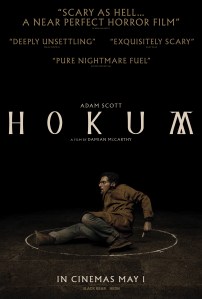
Hokum (2026):
Director: Damian McCarthy
Screenwriter: Damian McCarthy
Starring: Adam Scott, Florence Ordesh, Michael Patric, David Wilmot
The Plot: Successful novelist Ohm Bauman (Adam Scott) visits the inn where his parents honeymooned in Ireland so he can scatter their ashes. After a local woman (Florence Ordesh) vanishes from the hotel on Halloween, Ohm suspects foul play. Could one of her coworkers at the hotel be responsible? What about the local hermit (David Wilmot)? Or could there be some truth to local legends about a witch haunting the honeymoon suite?
Damian McCarthy makes scary movies. Oddity, his previous film, has the most effective jump scare I’ve seen in recent memory. The audience and character both know that it’s coming, but the sequence is so artfully constructed that it plays like something out of a nightmare. McCarthy’s films are chilly, steeped in an atmosphere of dread. Like its predecessor, part of what makes Hokum so frightening is the feeling that anything could happen. Watching Hokum reminded me a little of reading ‘Salem’s Lot for the first time. Like Stephen King, Damian McCarthy remembers how it feels to be afraid of the dark.
The King comparison extends beyond the director’s ability to tap into primal fears. McCarthy certainly isn’t beholden to King’s work, but the two artists share a fascination with the banality of evil. Oddity and Hokum each involve a character trying to solve a mystery; a murder, a disappearance. Without revealing the secrets of either film, mundane cruelties play as much of a factor as the supernatural.
Something I appreciate about Hokum is that while it does not shy away from darker elements, it also doesn’t wallow in the suffering of its characters. McCarthy is not a mean-spirited filmmaker. His films have a certain unsentimental morality. The innocent won’t always be saved, but the wicked get their just desserts. The occult exists as something beyond mortal reckoning, meting out punishment by an unforgiving and ancient code.
Characters are defined by how they treat others. Fiona, the missing hotel bartender, is funny and kind. She senses that something is off with Ohm and ends up saving his life after he attempts suicide. When he is discharged from the hospital weeks later and returns to the hotel to gather his things, Ohm learns what Fiona did for him and that she has disappeared. Though he is bitter and often rude, verging on cruel when speaking to fans, Ohm has an innate sense of decency. He understands what he owes to Fiona, and everything that follows stems from his attempts to make things right.
Adam Scott gives a pitch-perfect performance. Ohm is abrasive, but it’s clear that his rudeness is motivated by bitter self-recrimination over a traumatic childhood incident. He has no time for people who fawn over him, but warms to Fiona when she verbally spars with him. He connects with Jerry the hermit because Jerry treats him like a regular person instead of a famous author. Scott plays the character with exactly the right tone, often unlikable but never unsympathetic. The supporting cast are all excellent as well, particularly Florence Ordesh and David Wilmot. Even without the supernatural elements, Hokum would still have a compelling story to tell.
Hokum isn’t for everyone. It will be too frightening for some, too earnest for others. McCarthy also uses a framing device that isn’t entirely necessary, but which I liked anyway. Hokum has interesting, well-written characters. As a horror movie, it’s an artfully constructed descent into the depths. The violence is frank, but the film never shows too much because McCarthy knows that the worst terrors lie in the audience’s imagination.


