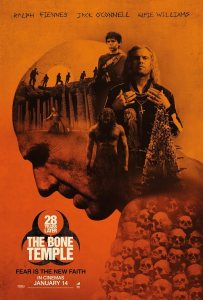
28 Years Later: The Bone Temple (2026):
Director: Nia DaCosta
Screenwriter: Alex Garland
Starring: Ralph Fiennes, Jack O’Connell, Alfie Williams, Erin Kellyman
The Plot: Immediately following the end of 28 Years Later, young Spike (Alfie Williams) is forced into a violent cult led by the sadistic madman Sir Lord Jimmy Crystal (Jack O’Connell). Meanwhile, Dr. Kelson (Ralph Fiennes) begins treating an unusual patient, the rage virus-infected Samson (Chi Lewis-Parry). Will Spike find allies within the cult? Can the good doctor discover a way to end this endless cycle of violence? Will Sir Jimmy Crystal win the approval of his father, who may or may not be Satan?
28 Years Later ended up being one of my favorite movies of 2025. In my review for last year’s Octoberween, I called it “an unexpectedly moving oddity”. Naturally, I went into the sequel with high hopes. I’m pleased to say that 28 Years Later: The Bone Temple (henceforth simply known as The Bone Temple) mostly delivers. Viewers who were put off by the previous film’s stylistic excesses will find more to like here. While I did miss Danny Boyle’s visual flair and the haunting beauty of the Young Fathers score, director Nia DaCosta hits the perfect tonal balance between gritty realism and mystical allegory. Hildur Guðnadóttir’s score is well-suited to accompany DaCosta’s work, moving between a more classical sound and modern ominous dissonance. Without giving too much away, the film also features some great needle-drops, including the best use of an Iron Maiden song I’ve ever seen.
Like the previous film, this movie wears its heart on its sleeve. Ralph Fiennes takes center stage this time. Ian Kelson is a kind but weary man, worn down by years of isolation. He spends his days memorializing the dead and listening to records in his bunker. He’s one of the few characters in the film with any memory of the world as it used to be, a place of “dramas and upheavals” but with foundations that “seemed unshakable”. Fiennes gives a typically wonderful performance, showing a core of strength beneath the gentle, lonely surface. The scenes between Kelson and the drugged out Alpha zombie Samson are genuinely touching.
As an antagonist and dramatic foil to Kelson, Jimmy Crystal is a compelling enough figure, made all the more so by a charismatic and chilling performance from Jack O’Connell. The Jimmy Saville-inspired blonde wig and tracksuit look almost works better in the isolated world of the film than it does in conversation with the real world. If Jimmy Crystal was a child when the first movie happened, the infamous pedophile was still a ubiquitous figure of British media*. Since British civilization collapsed in 2002 (when 28 Days Later was released), a post-apocalyptic cult leader borrowing Savile’s look makes as much sense in the context of the film as using Fireman Sam or Doctor Who as reference points.
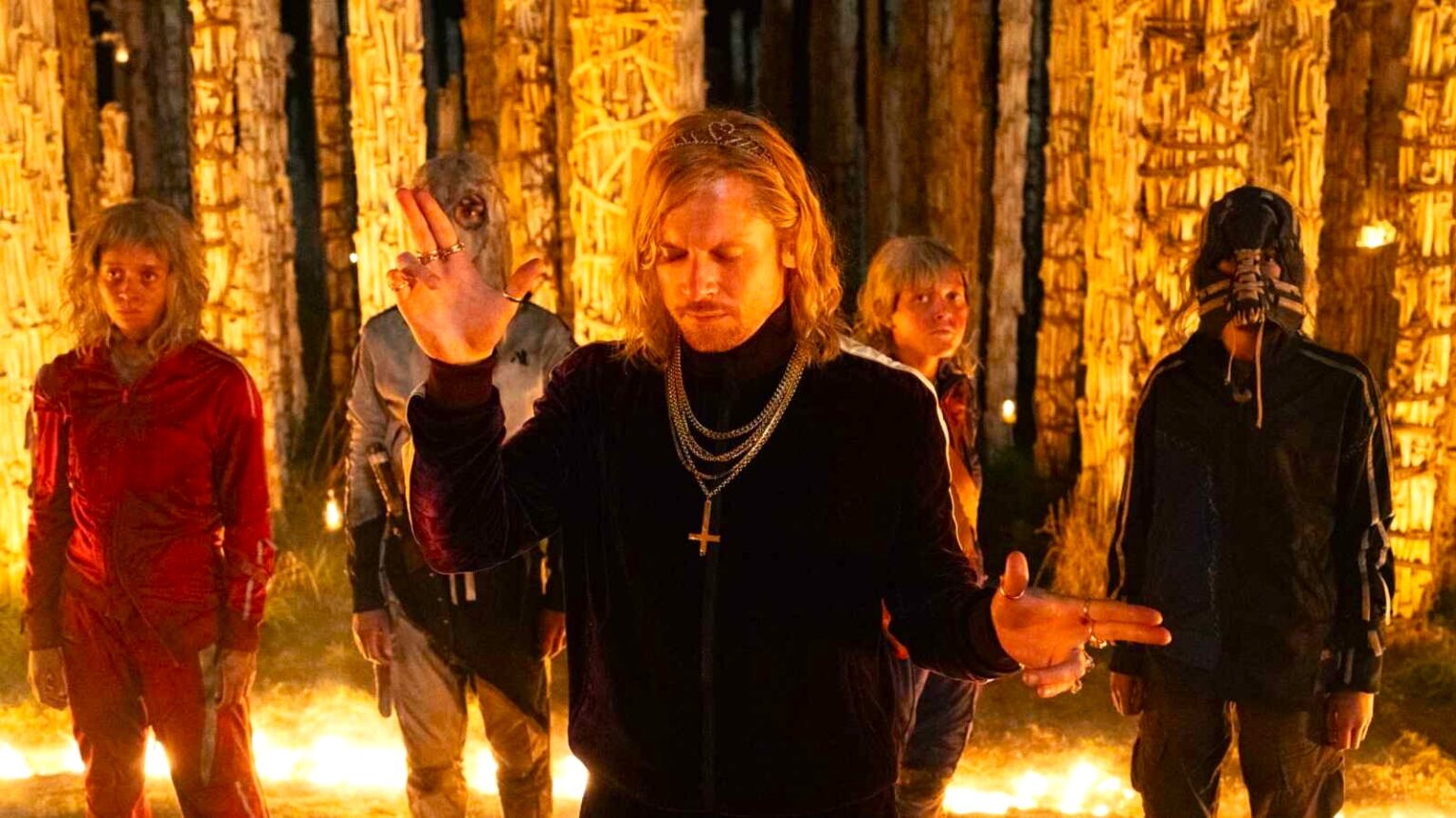
However, as a creative decision, all this feels a bit tacky. The 28 Days franchise is very gory and generally about as subtle as a brick, but invoking the specter of Savile isn’t quite as thought-provoking as it’s meant to be. It’s an edgy visual shortcut that signals “hey, this guy’s bad news”. The similarities between the two are largely superficial, at least. Jimmy Crystal’s Satan-worshiping cultist roves the ruined countryside with his band of younger acolytes, torturing and killing to feed his delusion that he is the son of the Devil. It’s to the film’s credit that it isn’t a direct commentary on the Savile case.
If I have an issue with The Bone Temple (a bone to pick, if you will), it’s that this film is more bluntly allegorical than its predecessor. Where 28 Years Later is character focused, using the coming-of-age story to explore broader themes of questioning authority and learning to live with loss, Alex Garland’s script for The Bone Temple tips the balance in the other direction. Spike’s sojourn into the wilderness exposes him to two very different (and very unsubtle) ideologies: the Jimmy Cult’s world is ruled by fear and superstition, while Dr. Kelson is guided by rationality and empathy. Though Spike still features in many scenes, he isn’t the driving force of the story anymore. He’s merely a horrified bystander to Jimmy Crystal’s gleeful cruelty (Spike is twelve, so it’s not like there’s much he could do in this situation). Spike is never tempted to join in when the Jimmies torture innocent people; the cult’s actions are too vile to be seductive.
The real message, rather than a simple “kindness good cruelty bad”, is that self-preservation is not worth the total abandonment of principle, nor does it justify the sacrifice of innocent lives. It’s a refreshingly noble sentiment, put forth in a refreshingly bold manner. I have my criticisms (I mean, it’s in the job title**), but a lack of commitment and originality is not among them.
28 Years Later: The Bone Temple is a weird, violent movie that’s also sincerely optimistic about the power of kindness in a world gone mad. I can’t fault anyone who finds it a stronger film than 28 Years Later; in many ways it is. For my part, I just didn’t have the same emotional connection. That’s the beauty of art, though. All of us, from the director to the stars to the amateur film critic to this site’s twelve dedicated readers, will have our own subjective reaction to the film. We bring our own histories and tastes with us wherever we go***.
*Those revelations didn’t come until 2012. I guess in the world of the film, Savile was never posthumously outed as a monster but was instead devoured by zombies.
**Film Criticismer.
***The shabby appeal of film criticism is that I get to spend a thousand words trying to walk the line between “how do I feel about this movie” and “how can I reasonably describe this movie so a reader can decide if they want to see it?” The duality of man, etc.

