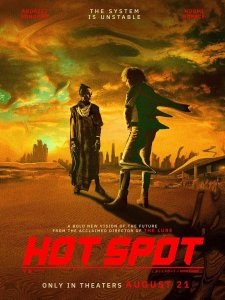
Hot Spot (2026):
Director: Agnieszka Smoczynska
Screenwriter: Robert Bolesto
Starring: Andrzej Konopka, Noomi Rapace, Reika Kirishima, George Aurimas Cris
The Plot: In a dystopian cyberpunk future, a sentient AI known as the Head rules over the survivors of a climate collapse. When private eye Djonny (Andrzej Konopka) is sent to investigate a ritualistic murder at a refugee camp, he uncovers a conspiracy that could undermine the Head’s total control. His initial suspect, a possible cyber witch named Rana (Noomi Rapace), ends up aiding his investigation. Or is she? As Djonny begins to lose his grip on reality, his wife Ayka (Reika Kirishima) and young son Zen (George Aurimas Cris) question their own acceptance of the status quo.
I loved director Agnieszka Smoczynska’s debut 2015 film The Lure, which I described in my review as a “Polish disco mermaid fairy tale”. Of the films she’s made since then, Hot Spot is the only one I’ve seen so far. While I’m in no position to take a big picture view of her development as an artist, The Lure and Hot Spot do make for an interesting double feature. Both take big aesthetic and tonal swings and are more concerned with emotions than plot.
Some of the bold choices in Hot Spot are more off-putting than others. The decision to have the actors all speak in English is an odd one on the surface. Lines that might have seemed poetic or profound in subtitles are instead a bit clunky. Hot Spot‘s international cast—Konopka, Rapace, and Kirishima are from Poland, Sweden, and Japan, respectively—are all talented actors but they come across as more wooden here than they have elsewhere. Konopka especially feels out of step with the material early on, although his blonde perm and tight outfits aren’t doing him any favors; the 1980s bad boy styling is at odds with his weathered face and sad eyes. On paper, he’s the perfect actor for a weary cyberpunk detective slipping into madness. The execution doesn’t quite land.
However, the somewhat stilted performances end up working in the film’s favor. Like all great sci-fi—or, indeed, all great fairy tales—Hot Spot is concerned with the problems of the modern age. Even the Luddites among us find it increasingly difficult to disengage from the new digital frontier. The internet has wormed its way into almost every facet of our lives. It’s a formless place, engineered to be addictive, to tug at the corners of our attention at all hours; the dopamine hits of a shopping mall and casino combined with the benumbed passivity of an afternoon spent flipping channels and the self-perpetuating righteous anger of 24-hour cable news*.
The characters in Hot Spot live lives of luxury in the desert ruins of decadent civilization, embodying fears of climate collapse and a global American internet that replaces cultural history with corporate nostalgia. All privacy and freedom have been surrendered to the Head in exchange for a purely illusory security. They are always online. After his mother briefly disconnects him from the Head to spare him from watching a live streamed public execution, Zen confesses:
I have some memories of when I still hadn’t met the Head yet, where I sit alone in my room and feel very well. Now I always feel like there’s someone with me. And I know it’s not a good feeling. I miss loneliness the most.
In a scene that exemplifies the director’s commitment to her vision, Djonny attends an avant-garde musical performance given by his wife Ayka. Before a crowd of sweaty dancers in a crowded nightclub, she sings lines like “your dreams are dreamt by everyone” and “we’ve been to the burial of joy”. “Belive and Die” is mournful yet urgent, an elegy for a dead world and a demand for Djonny and the blitzed-out dancers to confront what’s been right in front of them all along: What the Head takes, the citizens have given freely. All the human inheritance of joy, love, anger, lust, and sadness, offered up in exchange for a blandly comfortable life in service to an emotionless master that exists only to perpetuate itself. The Head/internet/ruling class is a parasite. You are the host.
While Hot Spot occasionally approaches the profound, it is still in many ways a messy movie. Wooden performances aside, Smoczynska’s focus on the emotional experience of her characters means that elements of the plot are rushed or underdeveloped. Rana and the rest of the refugees introduce interesting possibilities but end up mostly just serving as a catalyst for the drama between Djonny and Ayka. The director’s aesthetic vision remain as vibrant as ever, but there are times when her reach exceeds the limits of her budget, resulting in unintentional tonal clashes.
All that is to say that I really liked Hot Spot. Is it a great movie? Sometimes. Is it a bad movie? Sometimes. Will you like it? That’s something each of our twelve dedicated readers will have to find out for themselves.
*Insightful film criticism being of course the one silver lining.

