Nothing makes you feel old like your childhood becoming the new setting for nostalgic horror.
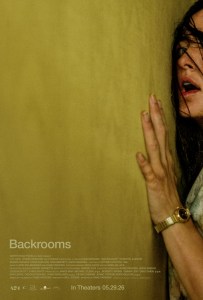
Backrooms (2026):
Director: Kane Parsons
Screenwriter: Will Soodik
Starring: Chiwetel Ejiofor, Renate Reinsve, Finn Bennett, Lukita Maxwell
The Plot: In 1990, freshly divorced and secretly living in his struggling furniture store, failed architect Clark (Chiwetel Ejiofor) discovers a hidden dimension in the store’s basement. He becomes obsessed with mapping out the liminal space, with its endless corridors and impossible architecture. After Clark vanishes, the film switches to the perspective of his therapist, Mary (Renate Reinsve). Processing her own traumatic past and guilt over not getting through to Clark, she follows him into the Backrooms. Is Clark lost forever? Is Mary?
Nobody can heave a sigh quite like my roommate’s dog, but I gave her a run for her money while watching Backrooms. The recent cultural phenomenon has the daring to ask such questions as: “What if the basement was bigger on the inside?” and “What if the decade that brought us “Baby Got Back” and Space Jam was an eerily quiet, dreamlike space?”
Backrooms captures the feeling of being creeped out in a store after closing, but has little to offer beyond that. It’s the product of a director whose media diet apparently consists largely of his own YouTube videos, with a few 90s commercial compilations and nostalgic TikToks thrown in for good measure. Parsons’ vision of the past is a copy of a copy of a copy; the “real world” in the film is as much a liminal space as the Backrooms. There’s so little contrast between the two that the characters feel untethered from reality even before getting trapped in the maze-like dimension. Production Designer Danny Vermette (Longlegs, The Monkey) does some excellent work, but it’s wasted on a film that’s all vibes, no substance.
Characters repeatedly compare the Backrooms to a picture of a dog drawn by someone who’s only ever had the animal described to them. That analogy applies just as aptly to the film’s setting and protagonists. Clark and Mary are both unhappy people, but are they meant to feel like hollow constructs? Even talented actors like Chiwetel Ejiofor and Renate Reinsve can only do so much. The script’s invocation of Cognitive Behavioral Therapy and faltering attempts to be about trauma feel half-baked and thuddingly literal instead of clever. It doesn’t help that much of the dialogue consists of characters either tensely describing their surroundings or simply reciting personality traits and backstory details. Maybe the latter works in therapy. Here, it’s repetitive and more than a little dull.
I don’t know if Werner Herzog was right when he condemned psychoanalysis for being one of the things that made the 20th century so terrible. It has contributed to some really irritating trends in 21st century screenwriting, though. If I have to hear one more conversation carried out in blunt therapy-speak I am going to scream. To give Soodik’s clunky script its due, at least these characters are actually in therapy. They just don’t sound like actual adults.
Parsons was only twenty when Backrooms came out this spring, which may account for some of the film’s more glaring flaws. Ham-fisted metaphors and technical incompetence are not the sole purview of youth, but Backrooms often feels like a student film with an A24 budget. The editing is sometimes unforgivably sloppy, with continuity errors and jarring cuts that take the audience out of the moment rather than convey the characters’ disorientation. The film does have some effective sequences, mostly when switching to a first-person perspective as video camera-wielding characters explore the Backrooms. The lo-fi aesthetic calls to mind the director’s YouTube series and lends the film an immediacy that it sorely lacks elsewhere.
Backrooms is a bad movie, but in many ways it’s still a promising first feature. Parsons has a talent for crafting atmosphere and memorable environments. Ten or fifteen years ago, his YouTube series could have landed him a job doing special effects or production design. I’m skeptical of the recent talk that social media is the future of entertainment. I suspect Hollywood has realized that content creators are an exploitable resource. Either way, Parsons might have benefited from the time to develop his craft before making the jump to feature films. Hopefully he’ll be able to mature in the spotlight.

