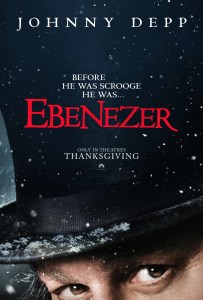
Ebeneezer (2026):
Director: Ti West
Screenwriter: Nathaniel Halpern, based on the novella by Charles Dickens
Starring: Johnny Depp, Rupert Grint, Andrea Riseborough, Travis Tillman, Sam Claflin, Daisy Ridley
The Plot: Bitter miser Ebenezer Scrooge (Johnny Depp) is visited by the ghost of his business partner Jacob Marley (Ian McKellen) on Christmas Eve; burdened by heavy chains forged in a lifetime of avarice, Marley tells Scrooge that tonight will be his only chance to redeem himself and avoid the same fate. Scrooge is visited by the ghosts of Christmas Past (Andrea Riseborough), Present (Travis Tillman), and Future (Robert Strange). Will the sights they show him be enough to change his wicked ways?
As if we needed another reason to re-watch The Muppet Christmas Carol this holiday season, here’s Ebenezer. Ti West’s adaptation—and it is an adaptation, making a few baffling changes but otherwise hewing closely to the plot of the novella—aims to highlight the creepier aspects of Dickens’ tale, but the film’s serious tone is constantly undermined by what has to be one of Johnny Depp’s worst performances. He shuffles through the film, alternately muttering and screeching lines. Scrooge plays as a cross between Mr. Burns and Danny DeVito’s Penguin. It’s like Depp is acting in a totally different movie, although it’s difficult to imagine what that movie could look like. Maybe Tim Burton would know.
If Ebenezer is meant to be Depp’s big Hollywood comeback after his European time out (getting “canceled” for domestic abuse just means working abroad for a bit if you’re really famous), then in a way it’s a success. This version of Scrooge fits right in with the roles he was playing ten years ago, a desperate clown beneath heavy layers of makeup and prosthetics. As an actor, he tipped over into shallow affectation long before his public fall from grace, and this feels like the logical next step in the devolutionary chain. It’s a shame, both because Depp was once capable of much better work, and because the rest of Ebenezer is often quite solid.
Much of the film’s strength comes from the supporting cast. Rupert Grint gives Bob Cratchit an undercurrent of desperate sadness without losing sight of the character’s open-hearted charm. Sam Claflin finds similar nuance beneath Fred’s cheerful exterior. Charlie Murphy manages to create a whole marital history in her big scene as Emily Cratchit. Daisy Ridley isn’t called upon to do much as Fred’s wife Clara, but fills the role exactly as needed (no small parts, etc.). Freddie Lee-Grey is…fine as Tiny Tim, although I’ve always found the character to be a Bit Much. Hearing Bob and Emily Cratchit talk about their sick child after putting the kids to bed hits much harder than anything Tiny Tim actually does onscreen, which isn’t really Lee-Grey’s fault.
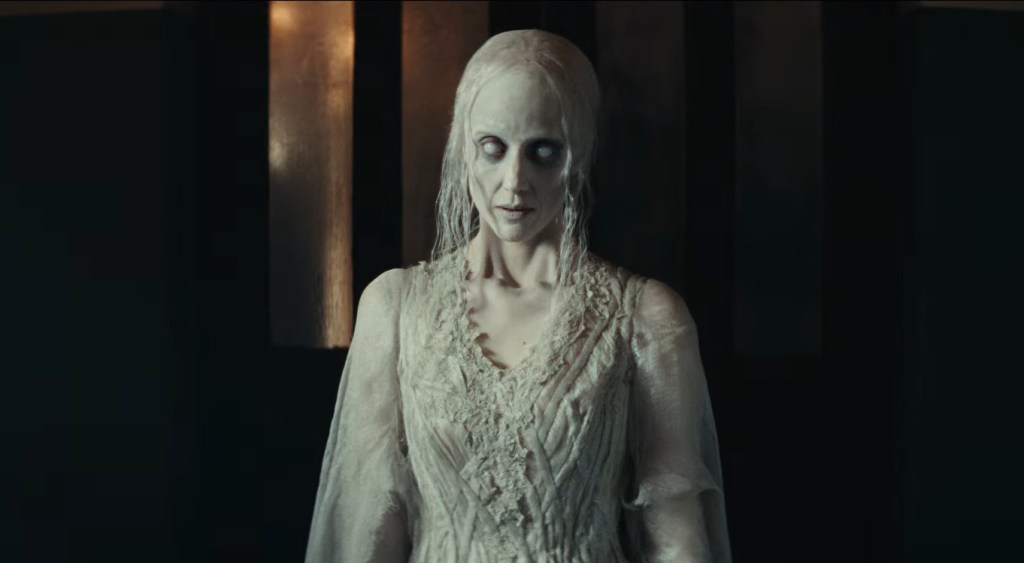
The highlight of the film is the trio of spirits that shepherd Scrooge on his dark night of the soul. Andrea Riseborough is particularly effective as the Ghost of Christmas Past, styled here to look like a spectral bride. With her white eyes and distant, unsympathetic line delivery, she’s imbues Scrooge’s trip to the past with an uneasy sense that these memories are being exhumed rather than simply revisited. She’s good enough that she almost elevates Depp’s performance by association. Travis Tillman’s Ghost of Christmas Present is similarly chilling; this version focuses on the spirit’s gluttony, with Tillman giving a thundering, resentful performance. Like Marley, the Christmas spirits are visiting Scrooge as penance for their own failures in life. Of the three, Robert Strange probably has the least to do as the Ghost of Christmas Future, but the tall, hooded figure is nonetheless well used.
West’s version of Dickensian London is suitably chilly and forbidding, although an over-reliance on “natural” lighting makes many interior scenes flat and dim instead of gloomy*. Eve Stewart’s production design and the costumes by Catherine George do a lot of the heavy lifting in setting the tone without drawing undue attention. The film around Depp is relatively grounded, possibly reflecting West’s roots in indie horror. To this critic’s untrained eye, the houses and clothing look reasonably historically accurate**.
Despite its miscalculated central performance and eerie tone, Ebenezer does manage to find some moments of poignancy. A montage of people singing “Silent Night” during the Ghost of Christmas Present section is genuinely moving. However, Nathaniel Halpern’s script has an odd tendency of undercutting Dickens’ messages of altruism and kindness with a streak of cynicism. It’s been a while since I’ve read A Christmas Carol, but I don’t remember any parts where beggars are revealed to be violent criminals (in this version, a beggar stabs to death young Scrooge’s mentor Fezziwig) and charities to be greedy frauds. Whether this is intended to supply nuance or update the story for modern audiences in unclear. As it stands, these scenes have the effect of aligning the film with Scrooge’s worldview before he’s visited by the ghosts.
Ebenezer is a film at odds with itself. If you can get past the lead performance and moments of ill-fitting cynicism, the film contains all the ingredients for a dark holiday classic. That lead performance is a large hurdle, though. As I texted to a friend after leaving the theater: “Muppets vindicated once again”. Michael Caine has never looked so good.
*Don’t get me started on natural lighting. Awful trend.
**Somewhere in the distance, an academic heaves a weary sigh. “Don’t get me started on bonnets.”

