Here at Rooster Illusion, we’re nothing if not timely. Relevance, that’s our watchword.
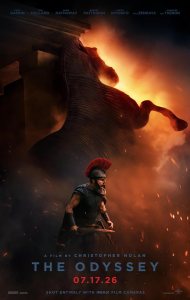
The Odyssey (2026):
Director: Christopher Nolan
Screenwriter: Christopher Nolan
Starring: Matt Damon, Anne Hathaway, Tom Holland, Robert Pattinson, Himesh Patel
The Plot: After spending ten years fighting in the Trojan war, Odysseus’ (Matt Damon) return journey to Ithaca is beset by calamity. While Odysseus faces the wrath of the gods and creatures like the Cyclops, back home his wife Penelope (Anne Hathaway) and now-grown son Telemachus (Tom Holland) contend with parasitic Suitors led by the conniving Antinous (Robert Pattinson).
There was a fair amount of Conservative pearl clutching prior to The Odyssey‘s release—black Helen of Troy, a transgender person existing; you know, the usual Culture War nonsense—but regular people had some qualms as well. Ahistorical costumes in an historical setting, modern American dialogue, Matt Damon of all people as Odysseus*. If you approach this as a straight adaptation of Homer’s epic you will likely be both disappointed and perplexed. This is Christopher Nolan’s version, in much the same way that Bram Stoker’s Dracula really belongs to Francis Ford Coppola (you can read my review of that film here).
The Odyssey features Nolan’s typical preoccupations with responsibility and leadership. As Second Breakfast writer Chris put it to me recently, “he makes movies about men in suits doing Important Jobs and feeling dour about their families”. Trade the crisp gray three-piece for a suit of armor and that’s Odysseus to a tee. It’s a characterization that works well for, say, Batman, but it’s an odd fit for Odysseus. Here, the wily but honorable King of Ithaca is still clever but very dour indeed. He’s haunted by the sacking of Troy and the deaths of his men on the long journey home. The former especially plagues him; Odysseus comes to view the Trojan Horse as the ultimate violation of Zeus’ Law, kick-starting a prolonged death of civility that presages the collapse of civilization. And he misses his family. It’s a lot of pressure.
Odysseus’ self-imposed burden of heavy responsibility feels very Nolan, but it’s interesting that the director has made two movies in a row dealing with driven men realizing that their life’s work may have doomed the world. Oppenheimer made a better case for it. Even with all the changes he makes to the original epic, there’s enough of The Odyssey in The Odyssey that the death of civility doesn’t fully land as a consequence of Odysseus’ actions. Men like the Suitors don’t twist the rules of hospitality because the Trojan Horse happened and now everything is fair game. They do it because they’re conniving bastards, and those have been around a lot longer than Ancient Greece. Maybe we’re always mourning the death of civility because we confer undue civility upon the past.
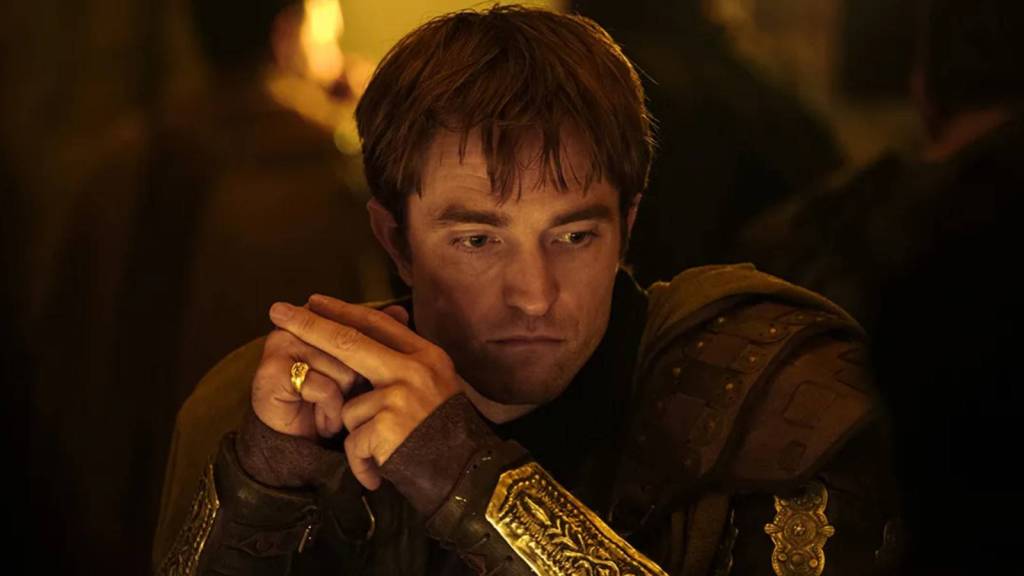
Nolan’s version of leadership also feels at odds with the setting of the film. Yes, a military leader or a king is responsible for his men, but he also expects them to be responsible for themselves and to follow orders like “don’t kill the cows of the Sun God”. Epics like The Odyssey or Beowulf are more about teaching people how to act correctly in society than they are about celebrating cool guys who kill monsters. Going in the opposite direction and asking “what if being a cool guy was really hard and maybe society wasn’t so great?” isn’t exactly a fresh take at this point, although one can see why it’s been resonating with modern audiences**.
On a technical level, Nolan’s filmmaking skills are undiminished. Once again working with Oppenheimer editor Jennifer Lame, the director jumps between timelines and storylines adroitly, complete with the trademark third act montage accompanied by a dramatic speech from the protagonist. Nolan remains one of the few blockbuster directors whose movies feel tactile. His continued use of practical effects wherever possible and tendency to film on location lend his films an immediacy that’s often lacking in green screen heavy tentpole movies and straight-to-streaming fare. The Odyssey features some beautiful scenery and set design, and Hoyte van Hoytema’s cinematography captures light and shadow in a way that never feels flat or murky.
There are some very effective sequences, like the visit to Circe (Samantha Morton). The transformation of the men into pigs is genuinely unsettling. What Nolan suggests is as creepy as what he shows. The scene with Odysseus communing with the dead is also very well staged; a sparse natural landscape, good lighting and makeup, and a moving performance from Elliot Page as Sinon create a more memorable Hades than all the CGI flames in Hollywood could have mustered. Moment to moment, The Odyssey is often very engaging. However, it frequently loses efficacy when characters open their mouths.
Setting aside questions of fidelity to the source material, Nolan’s script is the weakest part of The Odyssey. The dialogue feels blunt, even for him. Whether this is his way of reaching a larger audience ahead of Earth’s impending return to oral storytelling traditions amid plunging literacy rates, or the script just needed another pass, I can’t say. Modern phrases and American accents can be an effective way to connect contemporary audiences with ancient times—it worked for me in the 2011 Roman legionnaire film The Eagle, for example—but many of the lines here feel almost condescendingly simple. After the runaway success of Oppenheimer, maybe a little more faith in his audience would have been warranted.

This simplicity has a flattening effect on the characters. Matt Damon brings an everyman relatability to Odysseus, but doesn’t come across as a brilliant commander beloved by his men. Anne Hathaway is great as Penelope, but most of the depth comes from her performance. Penelope gets a few lines about the difficulties of her position, but much of her screentime is dedicated to telling her son that she wants her husband back. As Telemachus, Tom Holland has an even worse time of it. Adaptations often struggle with developing Odysseus’ son beyond a boy missing his father. Here, he reads as particularly naive. There’s nothing to suggest that he’s a worthy heir to the throne other than his name. Holland is fine, but this version of the character either needed to be played by an unknown 16-year old or given some additional thought.
Like Bram Stoker’s Dracula, Nolan’s The Odyssey is a movie that I didn’t really like but will inevitably end up rewatching to pick apart. Neither film works for me as an adaptation, but then again neither director is really trying to faithfully adapt the source material. Both films are visually stunning, with weak scripts and arguably miscast leads. Still, The Odyssey is not just another dumb blockbuster. It does have things on its mind, even if it doesn’t always communicate them effectively. I have to respect it for trying.
Nobody let Christopher Nolan make a Dracula movie, though.
*He’s a good actor, but Matt Damon has a face that’s heard of the steam train. I just don’t buy him in anything set before, like, 1800.
**None of our leaders are cool, civility in public discourse has really taken a beating over the last few decades, and maybe society isn’t so great.

