July 18th: My last day at MIFF, and a big day for documentaries from and about Maine. Featuring seven documentary short films from local filmmakers and a feature-length love letter to a hardcore music venue that doubled as a refuge for outcast teens. A long day, but a high note on which to end.

Maine Documentary Shorts
On the Sea (2025)
They Called Me a Rabble-Rouser (2025)
Second Responders (2025)
Home For Now (2025)
May the Water Not Freeze (2026)
Samland (2025)
Tides (2026)
As I said in my write-up of the Maine Narrative Shorts, one of my goals when attending MIFF was to see as many Maine-made films as I could. My final day at the festival was all local documentaries. This had more to do with complex scheduling than anything else, but it ended up being a fitting close to an excellent week. While it was great seeing films from across the globe, part of what makes MIFF unique is its embrace of local talent and continuing exploration and celebration of Maine’s character.
Reflecting the idiosyncrasies of the festival’s home state, the Maine Documentary Shorts presented a mixed bag of both tone and expertise. Films like They Called Me a Rabble-Rouser, Home For Now, and May the Water Not Freeze are clearly the work of passionate directors still honing their craft and developing interview skills. On the other end of the spectrum, Second Responders and Samland feel more professional from a production standpoint while remaining focused on their emotionally weighty subjects (public school teachers dealing with the fallout of the Lewiston mass shooting and a quirky inventor using art as a way to process the grief of losing his daughter, respectively).
The highlights for me ended up being the first and last films of this block. On the Sea is a fairly straightforward short documentary about the ways that changing regulations and global warming have affected lobster fishing and scallop farming. It’s only six minutes long, but I found it informative without being dry or overly-enamored with its interview subject. Director Carla Troconis also captures the natural beauty of the Maine coastline while still conveying the physical demands of the work.
Tides, the final documentary short, comes at a similar subject matter from a very different direction. If On the Sea is a traditional documentary, Tides is its experimental counterpart. It’s 22 minutes of stark black and white 16-mm film footage of lobster fishing and kelp harvesting, presented without dialogue. The film admittedly could have been half that length, but it features terrific sound design. Director Adam Sekuler often focuses on an individual element in a scene, like crates landing in a truck or the gentle rustling of drying kelp leaves. This approach forces the viewer to slow down and see the world as a complex series of overlapping parts, each unique but still part of the larger whole. Think of what you can hear now. An air conditioner? A distant lawnmower? Your poor laptop’s overworked fan? How many sounds do we hear without realizing it?
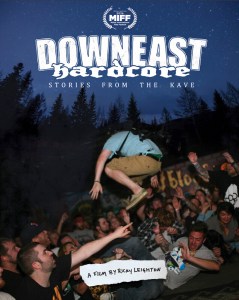
Downeast Hardcore: Stories from The Kave (2026):
Director: Ricky Leighton
Producers: Justine Conte, Samuel Gorelick
The Story: From 2001 to 2016, Kathy Findlay ran hardcore music venue The Kave in the barn outside her house in Bucksport, ME. By day an occupational therapy assistant at a nearby public school, Findlay saw The Kave as a safe haven and creative outlet for local outcast youth. Over time, the underground venue became a popular spot for local talent and major nationally touring hardcore bands. Findlay closed the venue after being diagnosed with Leukemia, but continues to be active in the Maine hardcore scene.
The last film I watched at MIFF was Downeast Hardcore: Stories from The Kave, a raucous and moving tribute to a lodestone of Maine’s hardcore scene. It’s a subject with which I only have a passing familiarity, so I appreciate director Ricky Leighton’s ability to make a film clearly intended for people who knew The Kave without alienating newbies like me.
For the uninitiated, “hardcore music” is a sub-genre of punk that’s sonically fast, loud, and aggressive. Vocalists will often scream lyrics, but most of that anger is directed towards authority figures and injustice. One of the interviewees in Downeast Hardcore laments growing up around people who always referred to hardcore as “kill yourself music”. He attempts to set the record straight by emphasizing the music’s often hopeful messages. I kind of think of it as music for depressed teens, so it might be more accurate to call it “don’t kill yourself music”. It’s not to my taste, but I’m glad it’s there for the people who need it.
Leighton’s film features interviews with band members who played at the venue and many of the “Kave Kids” who attended shows during their formative years (The Kave was an all-ages venue with a strict no drugs or alcohol policy). All of them speak passionately about the welcoming atmosphere and Findlay’s maternal presence. It makes for a loving tribute, but veers a bit close to hagiography at times. Downeast Hardcore definitely benefits from The Kave’s scrappy DIY charm and the no bullshit attitude of most of the people being interviewed. On a technical level, it’s well-directed and edited, with a good balance between archival footage and present-day interviews. It’s a promising start to what will hopefully be a lengthy career for Leighton.
Show with short film: North of Ordinary (2026):
Director: Sybil Patten
Producer: Sybil Patten
The Story: Founded in 1973 by Dora Lievow and Emanuel Pariser, the Community School provided an alternative resource for at-risk teens. The C-School gave students the opportunity to live in a small community and learn fundamental skills like cooking, cleaning, and social responsibility in addition to the regular curriculum.
North of Ordinary, an inspirational short documentary about hippies putting in the work to help teens who would otherwise have slipped through the cracks of one-size-fits-all public schooling, ended up pairing very well with Downeast Hardcore. Both the school and the venue were run by outcasts for outcasts, and each had an outsize influence on their respective communities.
Like Downeast Hardcore, this film is more celebratory than analytical. Still, it makes good use of its 37 minute runtime, charting the school’s inception and heyday and following up with some of the former students, who all had good things to say about their teachers.
And there you have it! My first trip to MIFF, but hopefully not my last.


Pingback: Rooster Illusion Goes to MIFF 29 | Rooster Illusion