July 14th: Big day for serious drama. Featuring a realistic story of addiction and recovery in Ohio, infidelity and attempted murder in 1920s China, and inter-generational conflict between rural midwives in the Andes.
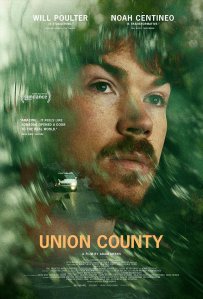
Union County (2026):
Director: Adam Meeks
Screenwriter: Adam Meeks
Producers: Brad Becker-Parton, Ellyn Daniels, Martha Gregory, Tim Headington, Will O’Connor, Theresa Steele Page, Will Poulter, Stephanie Roush, Faye Tsakas, Sean Weiner
Starring: Will Poulter, Kevin P. Braig, Annette Deao, Danny Wolohan, Noah Centineo, Sylvie Mix
The Plot: Recovering opioid addict Cody Parsons (Will Poulter) attends a mandatory drug court program. As he struggles with his own sobriety, he tries to atone for past mistakes and reckon with his role in his younger brother Jack’s (Noah Centino) drug addiction.
Director and screenwriter Adam Meeks takes an intimate, realistic approach to his material. Union County has an almost documentary feel at times. The supporting cast is mostly made up on non-actors, some of whom are participants in the actual recovery program depicted in the film. The film opens with short court-mandated testimonials, with recovering addicts giving updates on their progress. Meeks uses this device throughout as Cody moves through the program. These brief scenes are as moving as any of the more dramatic (yet still understated) moments driven by the plot, and contribute to the film’s effective combination of bracing honesty and heartbreaking fragility.
Emphasizing the non-actors isn’t a knock on the professional actors in the cast. Will Poulter gives an excellent, naturalistic performance, always conveying the depth beneath Cody’s subdued exterior. Noah Centino is similarly effective in a smaller but just as vital role. Union County is determined to treat its subjects with respect and dignity, and that carries through in Poulter’s work here. The film may end up being a little too low-key for its own good, but it’s hard to fault the director’s aims.
This is definitely worth a watch, but bring tissues. There wasn’t a dry eye in the house when I saw it.
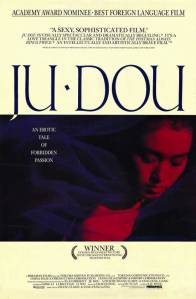
Ju Dou (1990):
Director: Fengliang Yang, Zhang Yimou
Screenwriter: Heng Liu
Producers: Hu Jian, Yasuyoshi Tokuma, Wenze Zhang
Starring: Gong Li, Baotian Li, Wei Li, Zhang Li, Ji-an Zheng
The Plot: Married off to the cruel and impotent owner of a dye mill, Ju Dou (Gong Li) finds respite in a torrid affair with her husband’s adult nephew. When she gives birth to a son, the lovers convince her husband that the boy is his. Festering secrets lead to a series of dramatic confrontations.
Look, I didn’t love this one. Every time I watch a Zhang Yimou film I admire the aesthetic beauty and find myself unable to connect with the characters. Ju Dou is not the exception. Still, Yimou’s use of color is often brilliant, finding sensuality in the vivid hues applied to endless bolts of fabric. The stark contrast between the bright dyes and the forbidding wooden mill mirrors the excitement and even relief of the affair.
I don’t believe that my inability to relate to the film’s characters necessarily results from their transgressions. Art isn’t limited to good people doing good things, and nor should it be. The film even goes out of its way to justify the infidelity. Jinshan, the husband, is almost absurdly cruel. He’s a rapist who tortured his last two wives to death. Ju Dou seeks out the affair with her nephew as much out of pragmatism as physical lust. The characters are trapped in their tiny world, which starts to shrink as consequences pile up. Ju Dou almost feels like a bleak fable.
I’m still not entirely sure why this movie didn’t click for me, which probably means that I need to watch it again. Who knows? Maybe I’ll do a Zhang Yimou week at some point, where I keep prodding his filmography until I can pin down what it is that bugs me. Then again, maybe not.
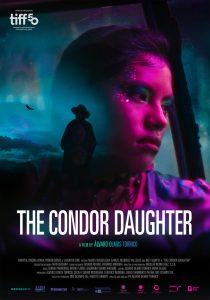
The Condor Daughter (2025):
Director: Alvaro Olmos Torrico
Screenwriter: Alvaro Olmos Torrico
Producers: Ocampo Gil, Federico Moreira, Cecilia Sueiro Mosquera, Diego E. Sarmiento Pagan, Iris Sigalit, Alvaro Olmos Torrico
Starring: Marisol Vallejos Montaño, María Magdalena Sanizo, Nely Huayta
The Plot: In the Andes, midwife Ana (María Magdalena Sanizo), teaches her adoptive daughter Clara (Marisol Vallejos Montaño) how to serve their isolated rural community. When Clara receives a radio as payment after a delivery, she starts dreaming of a life beyond the one she’s always known. If she leaves, can Ana find her and persuade her to come back? Is there even any future for this community or the old ways of midwifery in the modern world?
A joint production between Peru, Bolivia, and Uruguay, The Condor Daughter features some of the most beautiful scenery I saw at the festival. Director Alvaro Olmos Torrico and cinematographer Nicolás Wong capture both the majesty and isolation of the Andes in a way that complements the drama unfolding between the characters. We understand why Ana and Clara love their home, and also why Clara wants so badly to leave.
This even-handedness is perhaps the film’s greatest strength. Neither main character is perfect, and neither is wholly at fault. Montaño and Sanizo both give subtle, nuanced performances, making the most impact in quiet moments. The film tips its hand towards the end, leaning into the sacredness of traditional medicine in a way that feels at odds with the quiet realism of the preceding hour and a half, but it’s not enough to sour an otherwise well-made drama. I’m not disparaging the miracle of childbirth, the moment just feels heavy-handed.
If The Condor Daughter gets a wider release in the US, I think it will find an audience.


Pingback: Rooster Illusion Goes to MIFF 29 | Rooster Illusion